Buying Kamloops Real Estate: Costs, Fees, Taxes and Other Expenses

Once you know what kind of mortgage you want and the price of the house you can afford in Kamloops, you should add up all of the other costs involved in buying a home so that you know the true cost of buying your home.

When you buy a house, it isn’t only the cost of the house that you need to save for. Don’t forget these other costs:

Appraisal Fee
An appraisal is an estimate of the value of the home. Your bank or credit union may require that the property be appraised at your expense.

Deposit
A deposit is required to ensure that the buyer is serious about purchasing the home. It can form part of your down payment, but it must be paid when you make the Offer to Purchase.

Down Payment
You will need a down payment (money paid up front) to obtain a mortgage. With a down payment of 20 per cent or more of the home’s price, you can obtain a conventional mortgage. Your down payment must be at least five per cent of a home’s price for you to benefit from a competitive interest rate.

Mortgage Loan Insurance Premium
If you have less than a 20 per cent down payment, your bank or credit union may require that you buy mortgage loan insurance. You can add the mortgage insurance premium to your mortgage or pay the full amount when you close the sale on the house.

Home Inspection Fee
A home inspection, which costs typically around $500 to $1,000 in Kamloops, is a report on the condition of your home. You may want to make your inspection a condition of your Offer to Purchase, to make sure you are aware of the condition of the house before you agree to buy.

Estoppel Certificate Fee
This fee applies only if you are buying a condominium in a strata development.

GST
This is applicable on new construction typically. GST is 5% of the purchase price. There are thresholds where if GST is applicable the Property Transfer Tax is exempt. GST can also come in the play when a home is used as a business.

Property Transfer Tax
You pay Property Transfer Tax when you purchase or acquire an interest in a property. The tax must be paid when you register changes to a certificate of title with the Land Title Office. The amount of tax due depends on the fair market value of the property that is transferred:

  • If the fair market value is $200,000 or less, the tax is 1% of the fair market value.
  • If the fair market value is greater than $200,000, the tax is 1% of the fair market value up to $200,000, plus 2% on the portion of the fair market value that is greater than $200,000.

First time home buyers are often exempt from this tax.

Prepaid Property Taxes and/or Utility Bills
These charges are meant to reimburse the person who is selling the house for amounts already paid for, such as property taxes, filling the oil tank, etc.

Property Insurance
The insurance covers the cost of replacing the structure of your home and its contents. Property insurance must be in place on the day you close the sale.

Survey or Certificate of Location Cost
The bank or credit union may ask for an up-to-date survey or certificate of location prior to finalizing the mortgage loan. This can range in price.

Legal Fees
These fees must be paid when the sale is completed by a lawyer or notary.

Title Insurance
Your bank or credit union, or lawyer/notary, may suggest insurance to cover any loss caused by problems in the ownership of the property.

Water Tests
If the home has a well, you will want to test the quality and quantity of the water to ensure supply is adequate and the water is drinkable.

Septic Tank
If the house has a septic tank, you will want to have it inspected to make sure it is in good working order.

Other Costs to Consider:

  • Appliances
  • Gardening expenses
  • Snow-clearing equipment
  • Window coverings
  • Decorating materials
  • Moving expenses
  • Renovations or repairs
  • Service hook-up fees
  • Condominium fee

Click here for a printable guide. This information was provided by CMHC and the Government of British Columbia websites.

How To Avoid The Most Common Buyer Errors When Purchasing Kamloops Real Estate

contract to purchase buyer mistakes kamloops real estate home saleShopping for a new Kamloops home is an exciting experience. It also can be emotional, time consuming, expensive and comes with a myriad of details. Some buyers get caught up in the excitement of buying a new home tend to overlook some items. Their home purchase turns into an expensive process. These errors generally fall into three areas:

* Paying too much
* Losing a dream home to another buyer
* Buying the wrong home

Click Here for a detailed Buyer’s guide.

When you have a systematic plan before you shop, you will be sure to avoid these costly errors. Here are some tips on making the most of your home purchase:

Making an offer on a home without being pre-qualified
Pre-qualification will make your life easier—so take the time to speak with a bank or mortgage broker. Their specific questions in regard to income, debt, etc., will help you determine the price range you can afford. It is an important step on the path to home ownership.

Not having a home inspection
Trying to save money today can end up costing you tomorrow. A qualified home inspector will detect issues that many buyers can overlook. You will have an idea about future repairs that will need to be made to the home and often you will be provided with a general idea of cost for those repairs.

Limiting your search to open houses, internet and newspaper ads
Many homes listed in magazines or newspapers have already been sold by the time the issue comes out in print. Open houses are a good way to start but once you are serious about finding a home a Realtor can provide you with up to date information on new listings that is not readily available to the general public. The public MLS website is 2-4 days behind the system Realtors have access to.

Choosing a Realtor who is not committed to forming a strong business relationship
Making a connection with the right Realtor is crucial. Choose a professional who is dedicated to serving your needs before, during and after the sale. There are a number of part time Realtors that sell Real Estate, would you want a part time surgeon operating on you?

Thinking there is only one perfect house out there

Buying a home is a process of elimination, not selection. New properties arrive on the market daily, so be open to all possibilities. Ask your Realtor for a comparative market analysis. This compares similar homes that have recently sold or are still for sale. This will give you a broader view of the market.

Not considering long-term needs

It is important to think ahead. Will the home suit your needs three to five years from now?

Not examining insurance issues
Purchase adequate home owner insurance. Advice from an insurance agent can provide you with answers to any concerns you may have.

Making an offer with too few subjects
It is important to have subjects in your contract to purchase a home. Typically buyers only think of subject to financing (or first mortgage) and subject to a home inspection. There are also a couple other important terms such as:

  • Searching title to ensure it is free of any encumbrances.
  • Reviewing and approving a Property Disclosure Statement provided by the selling party.
  • Obtaining home insurance or fire insurance.
  • Reviewing and approving a Building Information Request which will show any outstanding permits on a property.
  • If a strata title property reviewing and approving all the strata minutes, bylaws, etc.

Ensure your best interests are protected.

Not knowing all the costs involved
Early in the buying process ask your Realtor and Mortgage broker for an estimate of closing costs. Title insurance and lawyer fees should be considered and many pre-pay responsibilities like property taxes, municipal fees and fuel adjustments must also be taken into account.

Not following through on due diligence
Buyers should make a list of any concerns they have relating to issues such as; crime rates, schools, power lines, neighbours, environmental conditions, etc. Ask the important questions BEFORE you make an offer on a home. Be diligent so that you can have confidence in your purchase.

There are many important steps when purchasing real estate. Click here to review the purchase process.

Click Here for a detailed Buyer’s guide.

Kamloops and District Real Estate Associations Statistics For November 2010

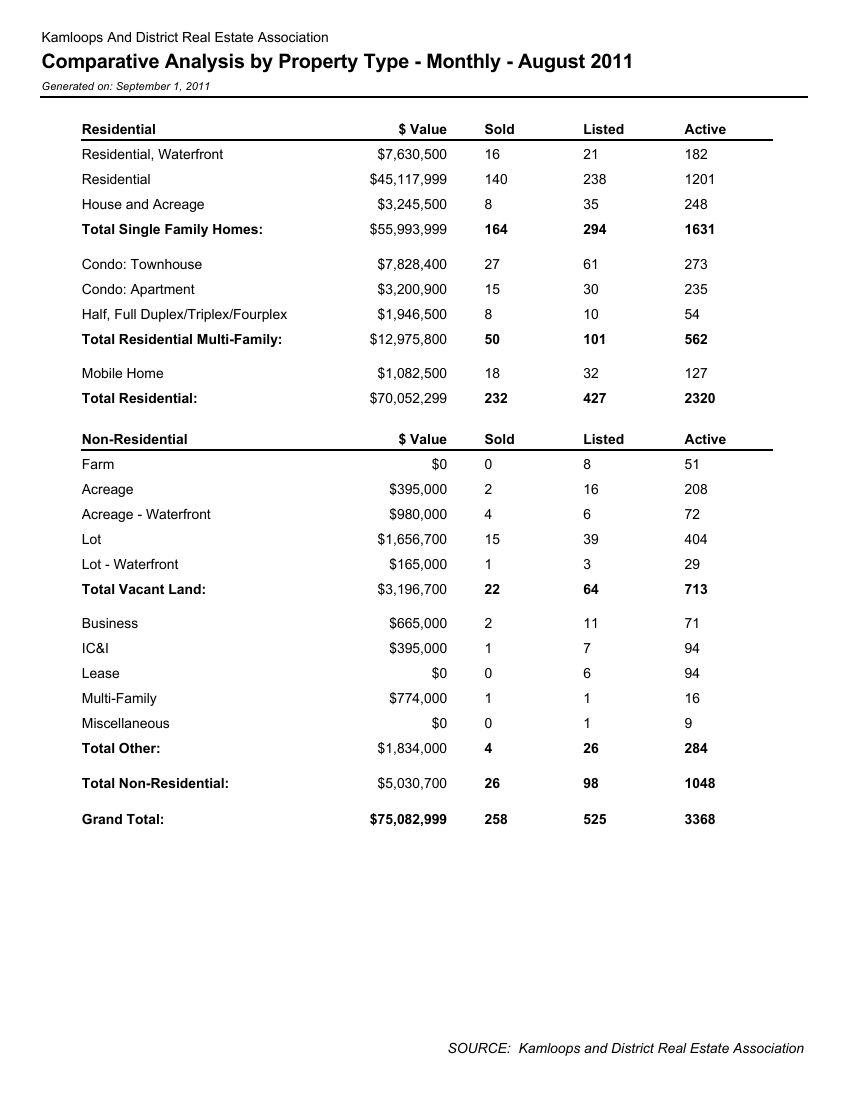
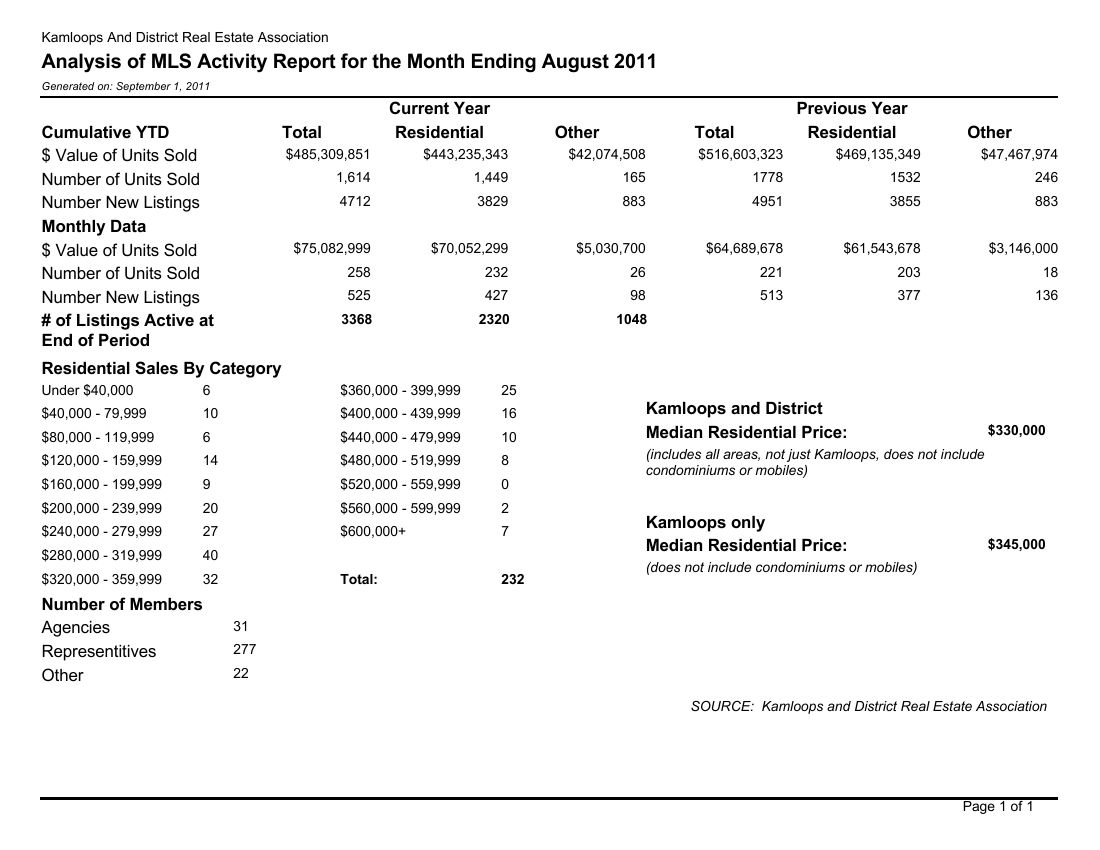
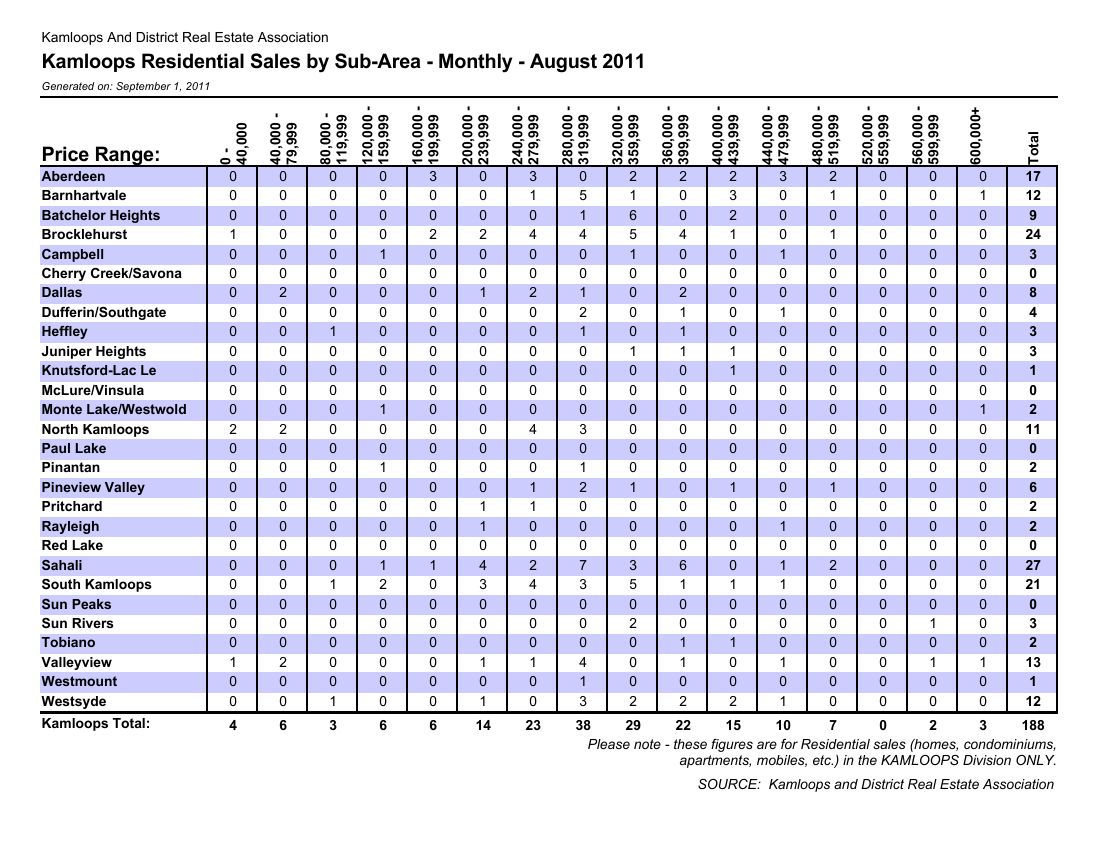
The Kamloops and District Real Estate Association has posted it’s latest statistics for November 2010. The number of residential sales are down in comparison to the same month last year however sales are slightly up in comparison to last month. Click on the images below to enlarge.

Comparative analysis by property type November 2010 Kamloops Real Estate Statistics0000

Kamloops Real Estate Comparative Analysis By Property Type November 2010

MLS Activity November 2010 Kamloops Real Estate Statistics

Kamloops Real Estate MLS Activity November 2010

Sales by Subarea November 2010 Kamloops Real Estate Statistics

Kamloops Real Estate Sales by Subarea November 2010

Canadian Housing Affordability Improves In The 3rd Quarter Of 2010: RBC

home for sale sold sign kamloops real estate mls listing kirsten masonDropping mortgage rates and softer house prices pushed housing affordability higher in the third quarter, the Royal Bank of Canada said in its quarterly housing report Monday.

The bank’s affordability index measures how much pre-tax income is required to cover all the costs associated with owning a home. Broadly, the index monitors the costs of condos, detached bungalows and two-storey homes. It was the first time that home affordability has improved in four quarters.

The quarterly report said the index dropped at the national level by between 1.4 and 2.5 percentage points from the second quarter (meaning affordability improved) depending on the type of property. Such a range is still above the long-term average. Bungalow costs fell by 2.4 percentage points between the second and third quarters, to 40.4 per cent of pretax income. That’s still 0.3 percentage points above the third quarter of 2009, when Canada was just beginning to come out of a major recession, and above the 15-year average of 39 per cent.

The situation was similar with standard two-storey homes, which gobbled up 46.3 per cent of pre-tax income — 2.5 percentage points less than in the second quarter of 2010 but up 0.3 percentage point from the third quarter of 2009. The average measure for two-storey homes, since RBC began compiling the numbers in 1985, has been 43.3 per cent.

Modest retreat

National home prices have retreated modestly in recent months, as market conditions cooled considerably during the spring and summer from their earlier boil, the report found. “While this represented a decline from the second quarter, home prices were still 5.8 per cent to 6.8 per cent higher year-over-year.”

Condos remained the most affordable type of housing track, requiring 27.8 per cent of pre-tax income to cover mortgages, taxes and utilities and one percentage point above the long-term average of 26.8 per cent. However, the improvement from the second quarter of 2010 was only 1.4 per cent and remained 0.1 percentage point above the third quarter of 2009.

RBC says all provinces had improvements in housing affordability during the third quarter, especially British Columbia. However, the cost of home ownership in British Columbia remained high by historical standards — following increases that began in the first quarter of 2009. A detached bungalow in British Columbia consumed 59 per cent of pre-tax income, while two-storey homes ate up 67.5 per cent of income and condos required 32.9 per cent of pre-tax income — all above the national average.

Alberta and Manitoba are the only two provinces where the RBC Measures stand below their long-term average in all housing categories, an indication, the bank says, that there is little stress in these markets.

Link

1 193 194 195 196 197 224