Perfect senior downsizer in quiet 55+ park. Large living room & kitchen. Cozy family room & good size master with 2 piece ensuite. One additional bedroom for guests. New flooring, newer furnace & most new windows. Roof inspected & in good condition. Comfortable yard & deck to enjoy the nice summer weather. Comes with small garden shed out back.
To view all homes for sale in Kamloops click here.
Beautiful 0.45 acre flat cleared lot with large pine at rear of lot. Very close to Knouff Lake with lake views. Excellent building site. Roads are maintained year round, close to Sun Peaks and Kamloops. Great lake for the whole family. Some boat restrictions.
To view all homes for sale in Kamloops click here.
CIBC Economics released it’s latest report on July 7th, 2011. Click on any of the images or charts to enlarge.
The Canadian real estate market appears to have nine lives. Over the past two years, home owners and potential buyers primed themselves toward highly expected increases in borrowing cost—increases that were supposed to end the real estate party of the past decade—only to be pleasantly surprised as global economic and political uncertainties kept a lid on Canadian interest rates. The misfortunes of other nations prolonged the real estate boom here at home, but it is hardly a secret that Canadians, including the governor of their central bank, are becoming increasingly anxious regarding current housing valuations.
Is it a bubble? Glancing at popular metrics such as the price-to-income ratio or the price-to-rent ratio, it is tempting to conclude that the housing market is already in clear bubble territory and a huge crash is inevitable. Tempting, but probably wrong. When it comes to the Canadian real estate market at this stage of the cycle, any statement based on average numbers can be hugely misleading. The truth is buried in the details—and there the picture is still not pretty, but much less alarming.
House Prices—A Closer Look
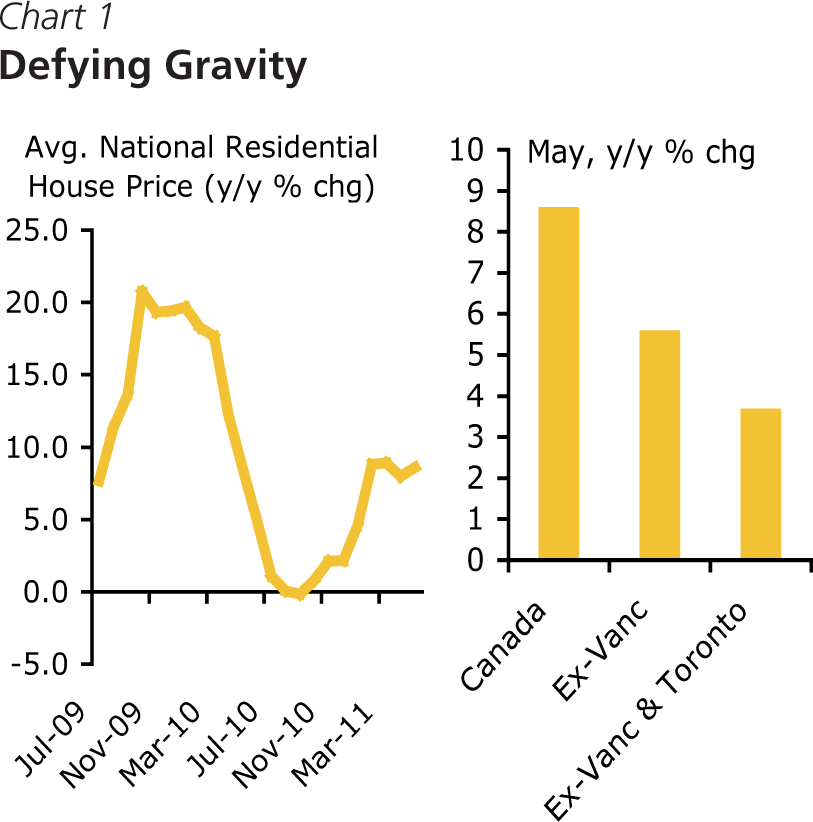
The average house price is still rising by 8.6% on a year-over-year basis. However, take Vancouver out of the picture and this rate slows to 5.6%. Exclude both Vancouver and Toronto and the price increase is only 3.7% (Chart 1).
Zooming in on the high profile Vancouver market, we see that the gap between average and median prices is approaching an all-time high—indicating a highly skewed market. In fact, removing properties that are above the $1 million mark reveals a much more moderate price appreciation and reduces the average sale price by $220,000 to just over $590,000. So what makes Vancouver abnormal is the high end of its property market.
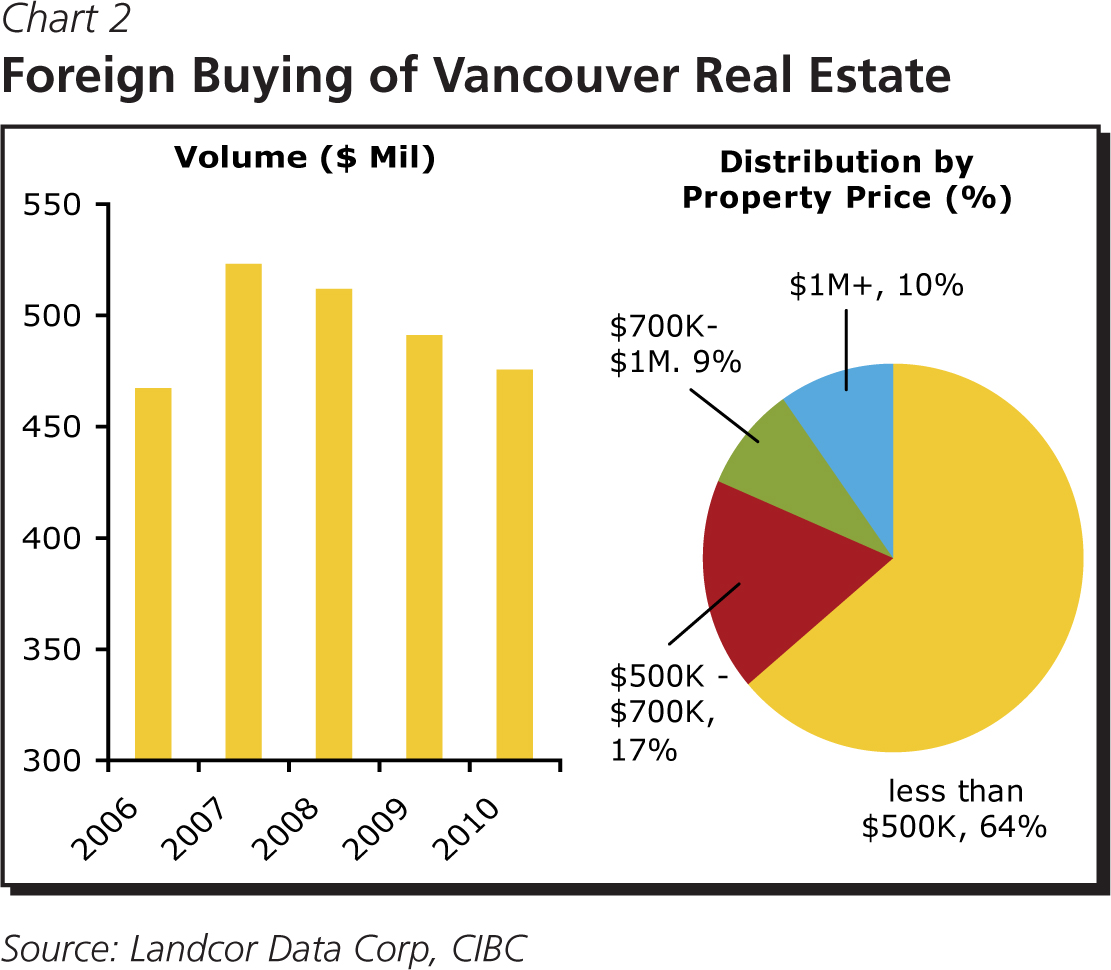
And in this context many, including Governor Carney, point the finger at foreign—mainly Asian wealth—as the main driver here. Data on the extent of that role is quite limited. Our analysis of data obtained from Landcor Data Corporation suggests that only 10% of the close to 4,500 transactions involving foreign money over the past five years were above the $1 million mark, with an average purchasing price of just under $600,000. In fact, according to the information provided by Landcor, foreign money accounted for only 2.6% of all sales (mostly condominiums) during the same period (Chart 2). However, that could be a serious underestimate, as it is based on where property tax assessments are mailed, and would exclude offshore buying on behalf of children or other local proxies. Furthermore, there are many reasons to believe that a significant portion of what is perceived to be buying by offshore investors is, in fact, driven by Chinese immigrants that are integrated into the community but still maintain strong links to mainland China, with many residing and working in China while their family establish roots in BC1. Note that, this activity is much more dominant in specific parts of the city, such as the west side.
So looking beyond the average price numbers reveals a highly segmented and multi-dimensional market that is probably influenced by different forces. But even a multidimensional market can overshoot—and the likelihood is that prices in the Canadian market and its sub-segments are higher than what can be explained by factors such as income growth, rent and household formation. Given that, the housing market will eventually correct. The only question is what will be the mechanism of that correction. A crash is, of course, the shortest route to equilibrium. But for such a scenario to materialize we need two pre-conditions: 1) a significant and quick rise in interest rates akin to the one that led to the 1991 recession and housing market correction, and/or 2) a high-risk mortgage market that is highly sensitive to any changes in economic realities, including hikes in interest rates. In fact, one can make the point that the US crash was a combination of these two conditions as the subprime market in the US started to melt only after the Fed began hiking and reset teaser rates, for hundreds of thousands of subprime mortgage holders, by roughly 400 basis points.
Pre-Conditions for a Crash in the Canadian Context
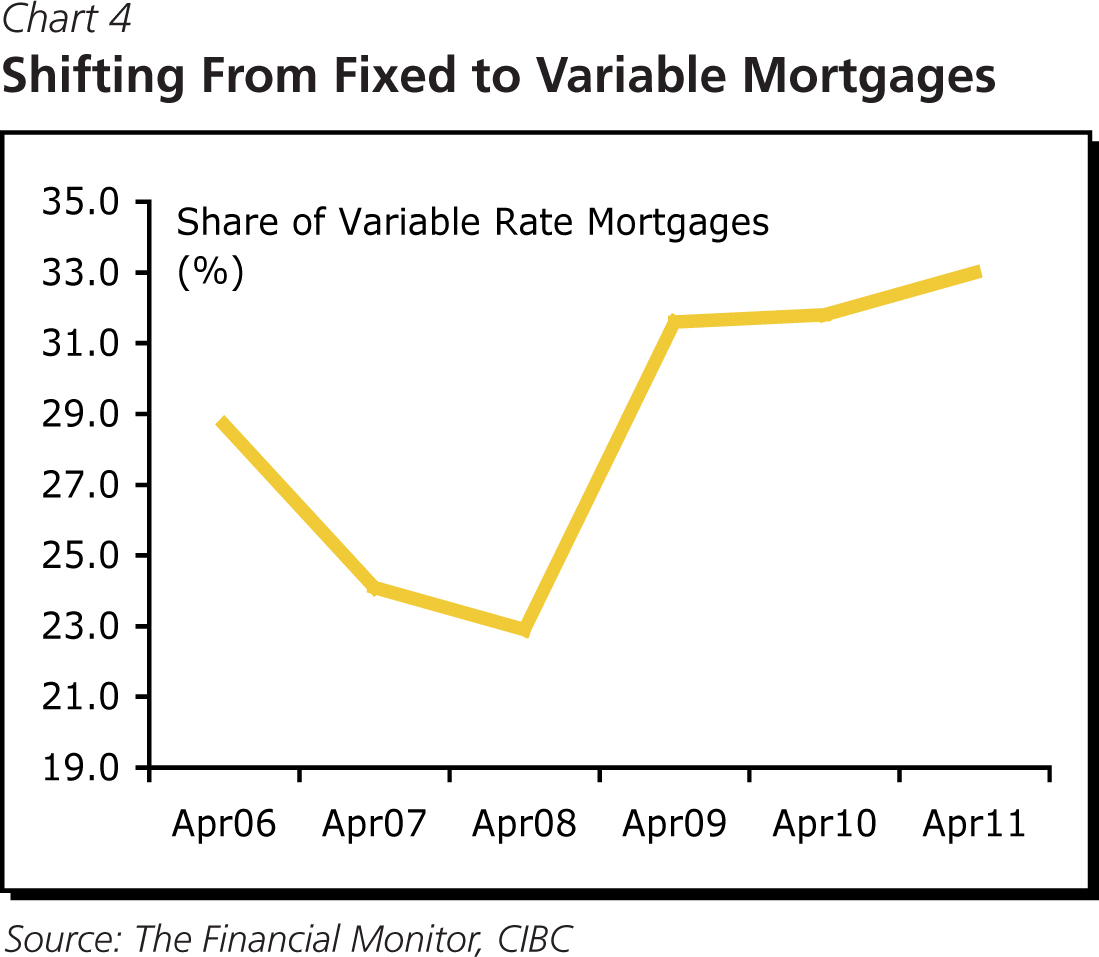
In Canada, a sharp and brisk tightening cycle is unlikely. The market expects a gradual increase in short-term rates in the coming years (Chart 3). The rising number of mortgage holders that carry a variable rate mortgage (Chart 4) will be the first to feel the pain, but if history is any guide, they will return quickly to the comfort of a five-year fixed rate the minute the Bank of Canada starts hiking.
What about the risk profile of the Canadian mortgage space? We zoom in on two sub-segments of the mortgage market that traditionally accounted for most defaults: mortgage holders that carry a debt-service ratio of more than 40% and those with less than 20% equity on their house.
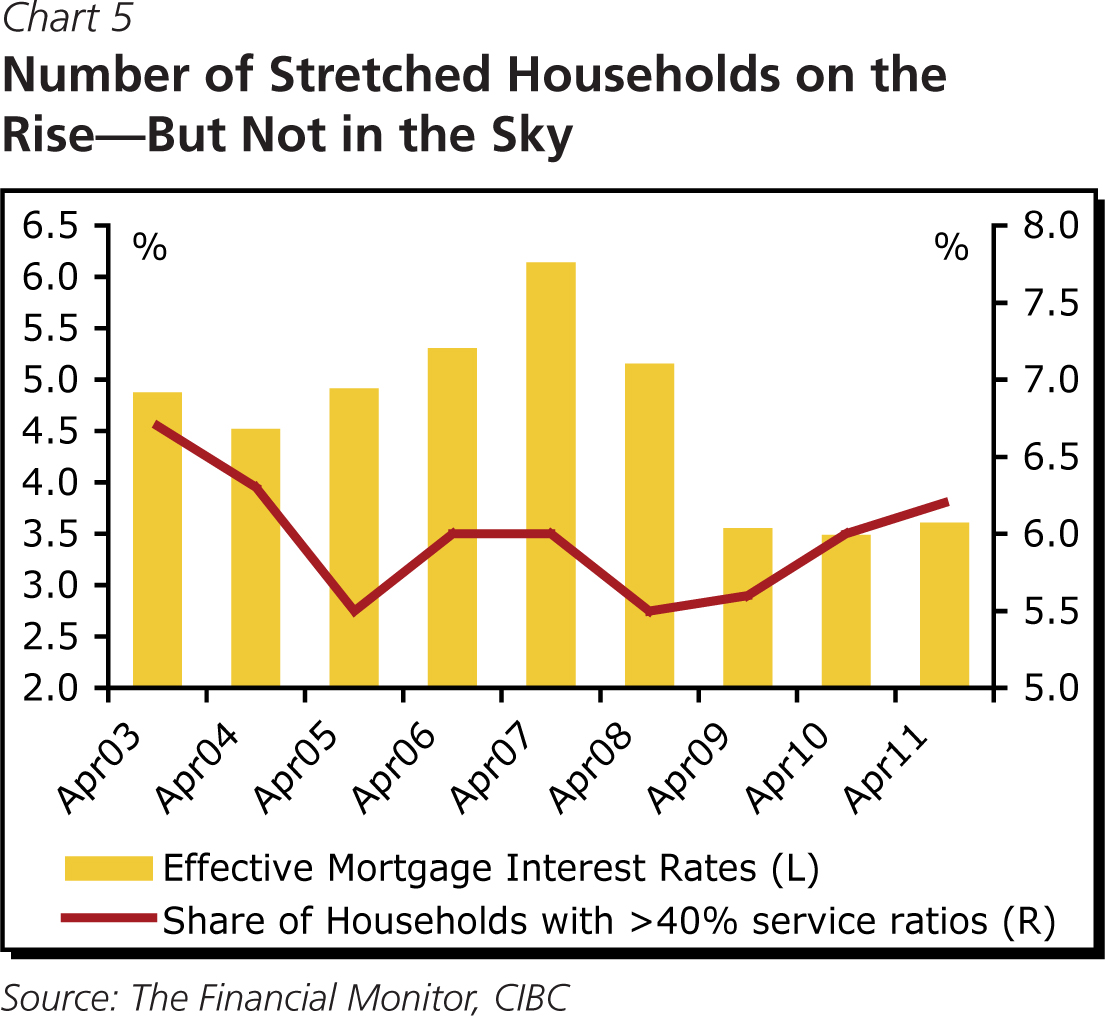
As illustrated in Chart 5, just over 6% of households have a debt service ratio of more than 40%—a number that has risen by a full percentage point since 2008. Note, however, that this ratio is still well below the ratio seen in 2003, when the effective interest rate on debt was more than a full percentage point higher, and no correction in house prices ensued. All other things being equal, even a 300-basis-points rate hike by the Bank of Canada would take this ratio to only just over 8%. Not surprisingly, Vancouver has the highest ratio of households with high debt-service ratio, followed by Toronto (Chart 6).
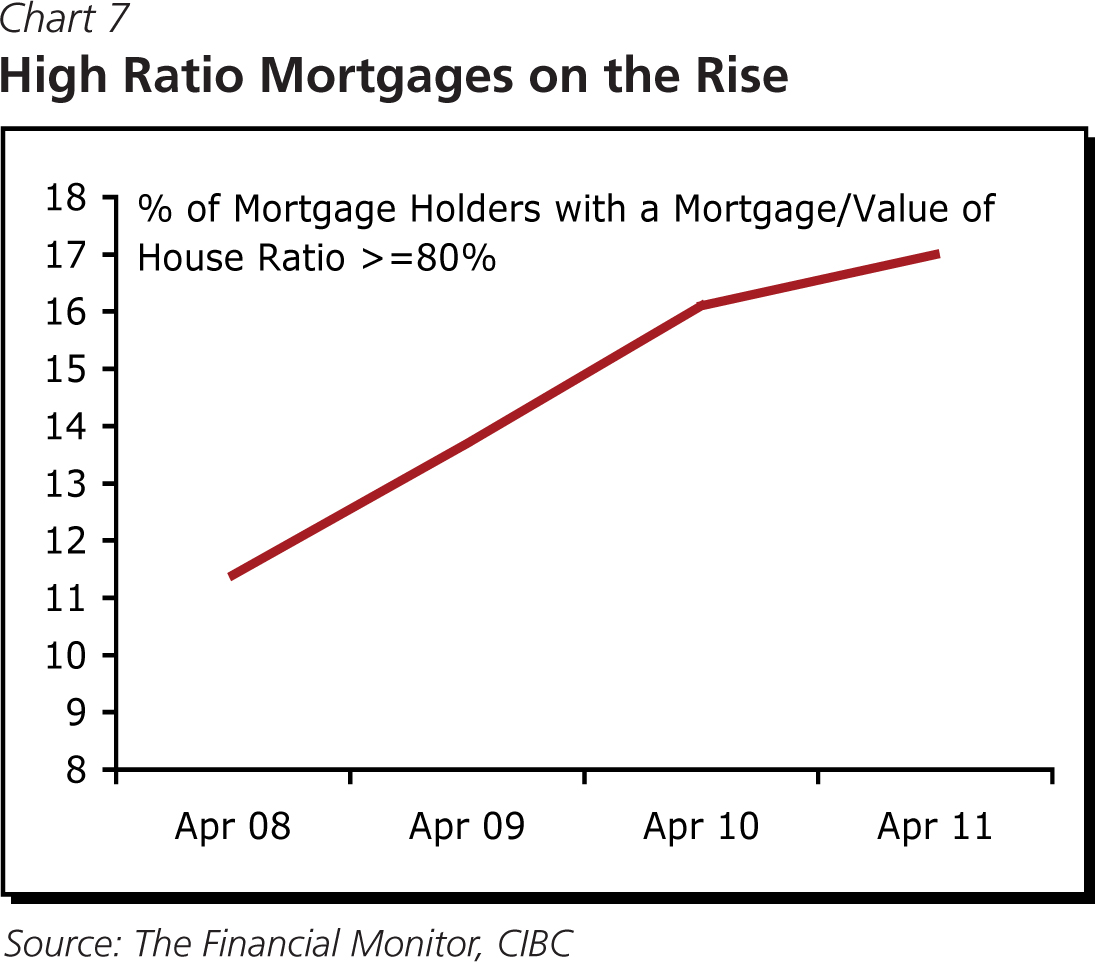
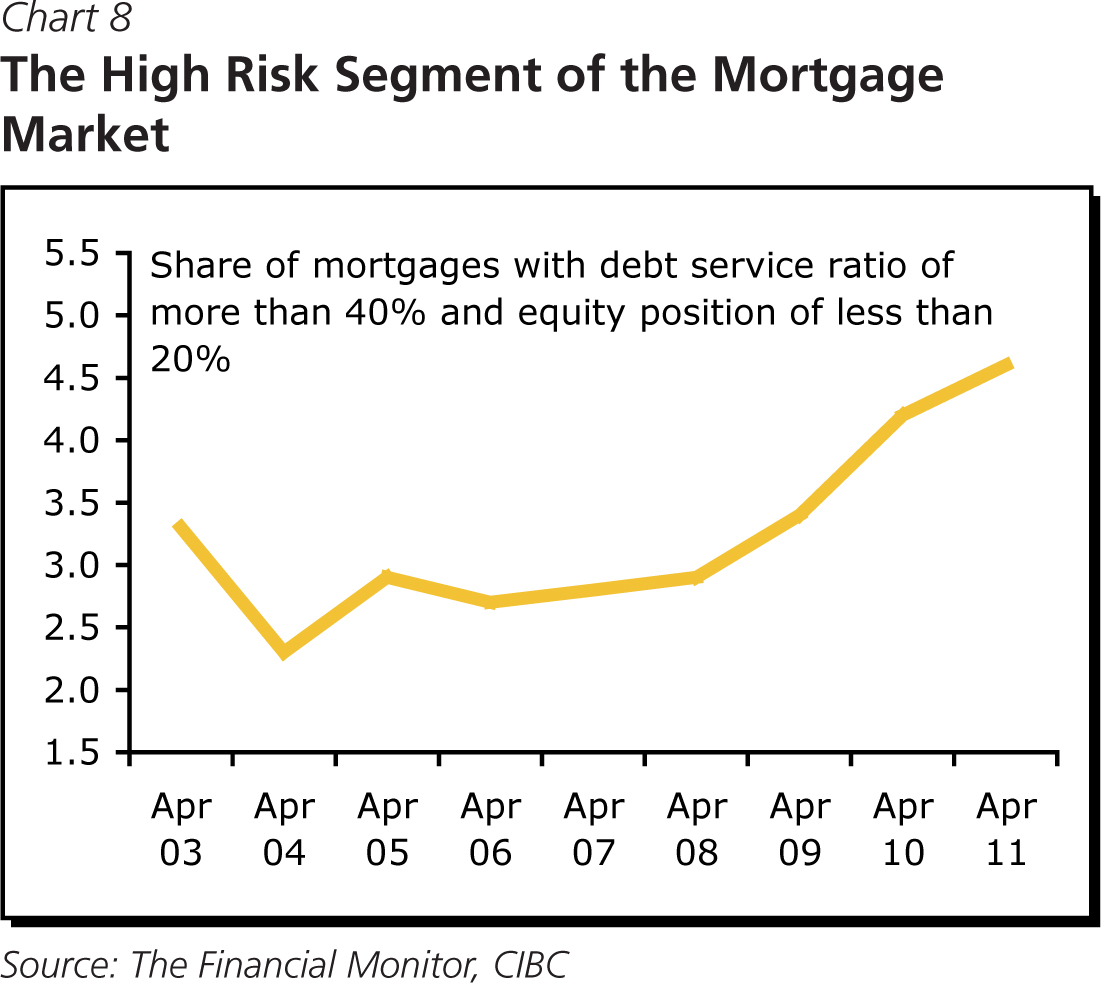
Moving on to the equity position, just over 17% of the Canadian residential real estate pool is in properties with less than a 20% equity position. Note that this number has been rising over the past few years (Chart 7). More than 80% of households with less than 20% equity position are first time buyers. Digging deeper and looking at the households with both low equity positions and high debt-service ratios, we found that this fragile segment of the market accounts for only 4.6% of total mortgages—a number that has been on an upward trend over the past few years (Chart 8). Shock the system with a 300-basis-points rate hike and that number would rise to a still-tempered 6.5%. Historically, even in that group, the default rate has been well below 1%. Thus, short of a huge macro shock, there does not appear to be the risk of large scale forced selling that would typically be the trigger for a precipitous plunge in the national average house price. As a result, while house prices are likely to adjust as interest rates eventually climb, the national pace of any correction is likely to be gradual. That could still entail a period in which housing under performs other assets as an investment class, until rising incomes and a tame price trajectory brings the market back to equilibrium.
Canada’s housing market has hit a peak and will likely slow in the next six months, says one of the country’s largest real estate companies, Royal LePage. “The market has seen its near-term peak in house price appreciation,” the company said in a forecast released Thursday. “A slower second half of the year is expected.”
The realtor group says home prices by the end of 2011 will be 7.7 per cent higher than they were at the end of 2010, on average. Sales volume is forecast to fall by two per cent over the same period.
High house prices are concealing early signs of a moderating market, the report said. The national average price of a detached bungalow has gained 7.5 per cent in the last 12 months to $356,625. ‘This trend cannot continue indefinitely’—Royal LePage CEO Phil Soper
Meanwhile, the price of a standard two-storey home rose 6.1 per cent to $390,163 and the price of a standard condominium rose 3.5 per cent to $238,064.
“In many of Canada’s regional markets, we saw house prices appreciate at a significantly faster rate than wages and salaries, and this trend cannot continue indefinitely,” Royal LePage CEO Phil Soper said.
Red hot Vancouver market bucks trend
There are wide regional variances within those numbers. The Canadian Real Estate Association has noted repeatedly in recent months that the national average price is being skewed higher by a red-hot Vancouver market, for example.
The Vancouver market continues its rally, Royal LePage says, with the average price of detached bungalows and standard two-storey homes both over $1 million and seeing double digit year-over-year gains.
It is interesting to note, however, that the average price for a standard Vancouver condominium saw a very modest increase of 2.5 per cent over the past year.
Soper noted that Vancouver — specifically certain neighbourhoods in the lower mainland of British Columbia — “remains an anomaly, as investment from outside of the country continues to support higher price levels.”
Other regions see gains
Most regions are still seeing strong gains, but home prices in Calgary declined modestly as the market continues to adjust following the Alberta housing boom experienced in the middle of the previous decade, the report noted.
The Atlantic provinces are still seeing gains, although smaller than the ones seen in recent quarters. And additional inventory coming on to the market in the Montreal area has provided home buyers with more choice and opportunities for negotiation, the report said.
Toronto’s seller’s market witnessed strong year-over-year price appreciation, with price gains ranging from 4.7 per cent to 6.1 for the housing types surveyed.
The company is predicted flat price gains in the fourth quarter of 2011 as the year-ago period was unusually strong.
The report makes no mention of the current mortgage rate environment. but it’s clear that borrowing costs are set to rise — something that could put pressure on home prices. Earlier this week, a couple of major banks raised their posted five-year fixed mortgage rates by .15 percentage points to 5.54 per cent.
The Bank of Canada is expected to resume raising its key overnight lending rate later this year. That will cause the interest rate for variable mortgages to rise.
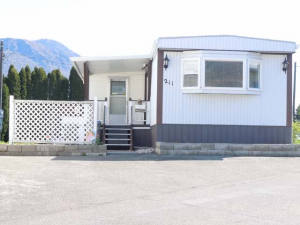 Perfect senior downsizer in quiet 55+ park. Large living room & kitchen. Cozy family room & good size master with 2 piece ensuite. One additional bedroom for guests. New flooring, newer furnace & most new windows. Roof inspected & in good condition. Comfortable yard & deck to enjoy the nice summer weather. Comes with small garden shed out back.
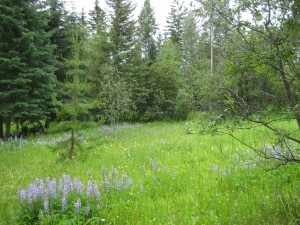 Beautiful 0.45 acre flat cleared lot with large pine at rear of lot. Very close to Knouff Lake with lake views. Excellent building site. Roads are maintained year round, close to Sun Peaks and Kamloops. Great lake for the whole family. Some boat restrictions.