February Home Sales Edge Lower, BCREA. Vancouver, BC – March 14, 2014. The British Columbia Real Estate Association (BCREA) reports that a total of 5,578 residential sales were recorded by the Multiple Listing Service® (MLS®) in February, up 24.9 per cent from February 2013. Total sales dollar volume was $3.4 billion, an increase of 43.1 per cent compared to a year ago. The average MLS® residential price in the province rose to $611,688, up 15.4 per cent from the same period last year.
“Consumer demand was much stronger in February compared to a year ago, but edged lower compared to January,” said Cameron Muir, BCREA Chief Economist. “Weak employment growth in 2013 has limited home sales so far this year to long-term average levels.”
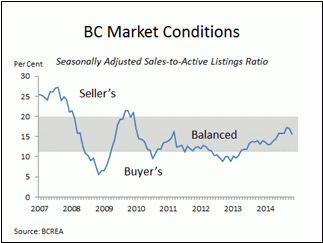
“Record low mortgage interest rates and population growth continue to underpin the housing market and most regions of the province are at or near balanced market conditions,” added Muir.
Year-to-date, BC residential sales dollar volume was up 10.1 per cent to $36.7 billion, compared to the same period last year. Residential unit sales were up 6 per cent to 68,510 units, while the average MLS® residential price was up 3.8 per cent at $535,411.
This article appeared on CBC.ca on February 28th, 2014 and was written by Pete Evans. CMHC Hikes Mortgage Insurance Premiums: Housing Agency Increases Amount Homebuyers Must Pay to Insure Their Loans
Canada’s national housing agency has increased the cost of insuring mortgages for homebuyers who make down payments of less than 20 per cent. Starting in May, the housing agency will charge an average of about 15 per cent more to insure mortgages, CMHC said in a release Friday. Prior to the announcement, the premiums ranged between 0.5 per cent and 2.75 per cent. Under the new rules, they will range from 0.6 per cent to 3.15 per cent.
The changes are unlikely to have a major effect on the housing market, but in real-dollar terms, the move makes it incrementally more expensive to buy a home. A heavily leveraged buyer — someone with only five per cent down, and therefore borrowing 95 per cent of the home’s value — would be most affected by the hike.
Under the old system, that borrower would pay an insurance premium of $6,875 to get a $250,000 mortgage. Under the new system, the premium would jump by $1,000. On a typical 25-year mortgage at 3.5 per cent, that person would be paying about $5 more every month. “This is not designed to affect housing market activity,” CMHC vice-president Steven Mennill said.
Mandatory insurance
Homebuyers in Canada are legally required to purchase mortgage insurance if they don’t put down 20 per cent of the price of the home up front. The homeowner pays for the insurance, but the lender is the beneficiary — it covers their losses if the homeowner defaults.
The vast majority of that insurance is sold through CMHC, although some private companies also offer it. Those companies, including Genworth Financial and Canada Guarantee tend to match whatever taxpayer-backed CMHC is charging.
True to form, Genworth did exactly that later on Friday, raising its insurance premiums to match CMHC’s.
“We believe this new pricing is prudent and more reflective of increased regulatory capital requirements,” Genworth chair Brian Hurley said. “These pricing actions are supportive of the long-term safety and stability of the Canadian housing market.”
Genworth shares jumped up by almost five per cent on the TSX following the news, a day after they gained more than three per cent as rumours of what CMHC was planning leaked out. Higher premiums mean more revenue for the insurer, which investors like.
CMHC charges a percentage fee for its insurance policies in the very low single-digits. Those percentages haven’t been raised since the late 1990s, and were in fact lowered from 2003 until 2005.
“The higher premiums reflect CMHC’s higher capital targets” Mennill said in a release. “CMHC’s capital holdings reduce Canadian taxpayers’ exposure to the housing market and contribute to the long-term stability of the financial system.”
The increase will only affect new policies, not mortgages already in existence.
CMHC said the new rules will apply to owner-occupied units and one-to-four-unit rental properties. It will also apply to self-employed owners. “This isn’t going to have a big impact on the mortgage market,” said Kelvin Mangaroo, the president of RateSupermarket.ca. “It’s more about getting their capital reserves in line.”
Considering how strong the housing market has been for the last decade, it’s not surprising that the CMHC has moved to adjust the premiums it charges to insure all that pricey housing stock, he said.
The BC Government recently released it’s 2014/2015 Budget and in that Budget changes were made to the First Time Home Buyers’ Program. The main change was to Property Transfer Tax and the exemption threshold which was increased to $475,000 from $425,000. This change applies to all registrations on or after February 19th, 2014. I have included information below regarding the First Time Home Buyers’ Program and how it works. It is always important to talk to your mortgage broker about this program to ensure that you do qualify for the exemption if you are a first time home buyer.
Information about Property Transfer Tax and the First Time Home Buyers’ Program (from BC Government Website)
The First Time Home Buyers’ Program reduces or eliminates the amount of property transfer tax you pay when you purchase your first home. If you qualify for the program, you may be eligible for either a full or partial exemption from the tax.
If one or more of the purchasers don’t qualify, only the percentage of interest that the first time home buyer(s) have in the property is eligible.
For example, if you qualify and purchase a property with a fair market value (see below) of $400,000 with a person that doesn’t qualify you would still qualify. If you owned a 60% interest in the property, 60% of the tax amount would be eligible for the exemption.
have lived in B.C. for 12 consecutive months immediately before the date you register the property or filed at least 2 income tax returns as a B.C. resident in the last 6 years
have never owned an interest in a principal residence anywhere in the world at any time
you have never received a first time home buyers’ exemption or refund
If you don’t qualify because you are not a Canadian citizen or permanent resident, but you become one within 12 months of when the property is registered, you may apply for a refund of the tax. To apply for a refund call (250) 387-0604.
Fair Market Value
Fair market value is the price that would be paid by a willing purchaser to a willing seller for a property (land and improvements) in the open market on the date of registration.
Open Market Transfers
A property transfer is considered to be in the open market when anyone likely to be interested in purchasing the property can make an offer. For example, the seller lists the property with a realtor or advertises it for sale.
The purchase price is considered the fair market value in most cases as long as you register the property within a few months of signing the sales contract. Otherwise, you will need to verify that the purchase price is fair market value if:
there was a significant change in value
the condition of the property changed
you didn’t purchase the property in the open market
Non-Open Market Transfers
When a property transfer doesn’t take place in the open market, fair market value may be determined using other means such as:
a recent independent appraisal, or
the property valuation provided by BC Assessment
Generally, the property valuation provided by BC Assessment reflects your property’s fair market value as of July 1 of the previous year. For example, the 2013 roll value reflects market conditions at July 1, 2012. This means that the assessed value may not reflect the current fair market value of your property.
The current property valuation provided by BC Assessment can’t be used in certain cases, such as when:
changes have been made to the property (e.g. rezoning) since the assessment
market conditions in the area of the property have changed since the assessment