Kamloops Real Estate Blog

BCREA Housing Market Update November 2014

BC Real Estate Association (BCREA) Chief Economist Cameron Muir discusses the October 2014 statistics.

Year-to-Date Home Sales Eclipse 2013 Annual Total

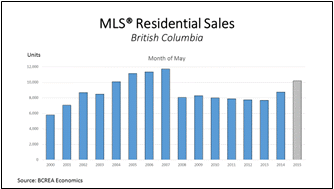
Vancouver, BC – November 14, 2014.  The British Columbia Real Estate Association (BCREA) reports that a total of 7,648 residential unit sales were recorded by the Multiple Listing Service® (MLS®) in October, up 14.6 per cent from October 2013. Total sales dollar volume was $4.4 billion, an increase of 22 per cent compared to a year ago. The average MLS® residential price in the province rose to $575,504, up 7.1 per cent from the same month last year.

“Consumer demand for housing continues at an elevated level,” said Cameron Muir, BCREA Chief Economist. “There were more homes purchased during the first ten months of the year than during all of 2013”. To the end of October, 73,001 homes have traded hands in the province compared to 72,936 for all of last year.

“Strong year-over-year increases in housing demand were experienced in Chilliwack (up 31 per cent), Victoria (up 21.9 per cent) and the Kootenay (up 19.4 per cent) market areas. Vancouver, Vancouver Island, the Fraser Valley and Okanagan Mainline also posted a marked increase in sales activity last month.”

Year-to-date, BC residential sales dollar volume was up 23 per cent to $41.4 billion, compared to the same period last year. Residential unit sales were up 15.8 per cent to 73,001 units, while the average MLS® residential price was up 6.2 per cent at $566,687.

BC Home Sales in 2014 Have Already Topped Last Year’s Total: BCREA

This article appeared on News 1130 on November 16th, 2014 by Richard Dettman.

BC Home Sales in 2014 Have Already Topped Last Year’s Total: BCREAProvince-wide average price last month rose 7.1 per cent.

VANCOUVER (NEWS1130) – Home sales in BC have topped last year’s total in just 10 months.

An industry group reports 73,000 homes were sold across BC to the end of October, beating the 12-month total for 2013.

In October, more than 7,600 residential unit sales were made through the Multiple Listing Service, up 14.6 per cent from a year earlier. The province-wide average price of a home rose 7.1 per cent to $575,000.

BC Real Estate Association chief economist Cameron Muir says “Strong year-over-year increases in housing demand were experienced in Chilliwack (up 31 per cent), Victoria (21.9 per cent), and the Kootenay (19.4 per cent).”

Pace of housing starts slows in October, says Canada Mortgage and Housing Corp., CTV News

Pace of housing starts slows in October, says Canada Mortgage and Housing Corp. This article appeared on CTV.ca on November 10th, 2014 and was written by The Canadian Press.

Canada Housing Starts BC Real Estate MLS ListingsOTTAWA — The pace of new home starts in Canada slowed in October due to less construction of multiple-unit homes including condominiums, Canada Mortgage and Housing Corp. says.

The agency estimated Monday the standalone monthly seasonally adjusted annual rate was 183,604 units in October, down from 197,355 the previous month.

Economists had expected a rate of 200,000, according to Thomson Reuters.

The decrease in October brought the six-month moving average down to 195,707 homes as of October, compared with 197,763 in September.

“The decrease in the trend reflects a decline, in October, of starts of multi-unit dwellings, including condominiums,” CMHC chief economist Bob Dugan said in a statement.

“Given the elevated level of condominium units under construction, our expectation is that condominium starts will continue to trend lower over the coming months.”

CMHC says the pace of urban housing starts in October decreased across the country, with declines led by British Columbia and followed by Quebec, Atlantic Canada, the Prairies and Ontario.

The overall drop in the pace of new home construction came as the rate of urban starts slowed to 164,683 in October, down from 177,053 in September.

The drop was due to a slower pace of multiple-unit urban starts which fell to 98,673 compared with 114,539 in September. The rate of single-detached urban starts segment increased to 66,010 from 62,514.

Rural starts recorded a seasonally adjusted annual rate of 18,921 in October.

TD Bank economist Brian DePratto noted that while the October results fell short of expectations, the trend over the last six months has still outperformed the bank’s expectations and has remained well above the 180,000 level needed to keep up with underlying population growth.

“In addition, the decline was led entirely by multiple-unit starts, which can be quite volatile,” DePratto wrote in a note to clients.

“With multi-unit construction growing as a share of overall new homebuilding (it now accounts for 60% of construction), monthly swings have become more volatile, and so longer-term trends provide a more appropriate gauge of the health of Canada’s construction industry.”

Property Sales in Canada Set to Rise by Almost 4% This Year

Property Sales in Canada Set to Rise by Almost 4% This Year. This article appeared on Propertywire.com on November 10th, 2014.

Residential property sales in Canada are forecast to increase by 3.8% this year compared to 2013, according to revised figures from the Canadian Real Estate Association (CREA).

The data reflects stronger than expected sales in recent months. Even so, sales activity is expected to peak in the third quarter as the impact of a deferred spring dissipates and continuing home price increases erode housing affordability.

This would place activity in 2014 slightly above but still broadly in line with its 10 year average. Despite periods of monthly volatility since the recession of 2008/2009, annual activity has remained stable within a fairly narrow range around its 10 year average. This stability contrasts sharply to the rapid growth in sales in the early 2000s prior to the recession.

British Columbia is forecast to post the largest year on year increase in activity at 11.9% followed closely by Alberta at 7.7%. Demand in both of these provinces is currently running at multi year highs.

Activity in Saskatchewan, Manitoba, Ontario, Quebec and New Brunswick is expected to come in roughly in line with 2013 levels, with sales increases ranging between 1% and 2% in the first three provinces and edging lower by about 1% lower sales in the latter two provinces. Sales in Nova Scotia and in Newfoundland and Labrador are projected to be down this year by 3.9% and 5.2% respectively.

Mortgage interest rates are expected to edge higher as Canadian exports, business investment, job growth, and incomes improve. These opposing factors should benefit housing markets where demand has been softer but prices have remained more affordable.

Sales in relatively less affordable housing markets are likely to be more sensitive to higher fixed mortgage rates, the CREA report also says.

National activity is now forecast to reach 473,100 units in 2015, representing a decline of four tenths of 1%. Sales activity is forecast to grow fastest in Nova Scotia at 3.3%, followed by Quebec with growth of 1.3% and New Brunswick at 1.3%. Alberta is the only other province forecast to post higher sales next year with growth of 1%.

In other provinces, activity is forecast to decline in the range of between 1% and 2%. In British Columbia and Ontario, this trend reflects eroding affordability for single family homes, the report says.

The national average price has evolved largely as expected since the spring, resulting in little change to CREA’s previous forecast so it is projected to rise by 5.9% to $405,000 in 2014, with similar price gains in British Columbia, Alberta, and Ontario. Increases of just below 3% are forecast for Saskatchewan, Manitoba and Prince Edward Island. Newfoundland and Labrador is forecast to see average home price rise by about 1% this year, while Quebec is forecast to see an increase half that size.

Prices are forecast to be flat in New Brunswick and recede by almost 2% in Nova Scotia. The national average price is forecast to edge up a further 0.7% in 2015 to $407,900. Alberta and Manitoba are forecast to post average price gains of almost 2% in 2015, followed closely by Ontario at 1.3%. Average prices in other provinces are forecast to remain stable, edging up by less than 1%.

Looking at the year so far, the CREA report says that the deferral of sales and listings during an extraordinarily bleak winter delayed the start to the spring home buying season. This deferral boosted activity in May and June as properties were snapped up after finally hitting the market, particularly in markets with a shortage of listings.

Although this boost was and still is expected to be transitory, sales have yet to show signs of cooling as activity strengthened slightly further over the summer. The increase reflects continuing strength in home sales among large urban markets that initially drove the spring rebound together with gains in markets where activity had previously struggled to gain traction. Lowered mortgage interest rates supported this trend.

1 147 148 149 150 151 223