CMHC Chief Says Housing Agency Considering Passing on Mortgage Risk to Banks, Financial Post

CMHC Chief Says Housing Agency Considering Passing on Mortgage Risk to Banks, Financial Post. This article appeared in the Financial Post on September 19th, 2014 and was written by Garry Marr.

CMHC Pass On Mortgage RiskThe Canada Mortgage and Housing Corp. is looking at changes to mortgage default insurance that would include sharing risk with banks, the Crown corporation’s chief executive told a Montreal audience Friday.

“In our role as an adviser to government, we are evaluating a range of ideas on future improvements to our housing finance system, including risk-sharing with lenders to further confront moral hazard, future sandbox changes if housing markets are to become less stable, and increased capital requirements,” Evan Siddall told the Saint James Club, according to notes posted on CMHC’s website.

The Financial Post reported this month CMHC was looking at a new formula to push some of its losses on to financial institutions, essentially forcing them to pay a deductible on mortgages insured with the Crown corporation before claims are paid.

Sources have said the Office of the Superintendent of Financial Institutions has been involved in discussions with CMHC, which it oversees, while the Canadian Bankers Association is said to be against the measure. The CBA said it has had a variety of discussions with CMHC about mortgage and housing issues.

Mr. Siddall said in his speech that while Canada weathered the 2008 financial crisis it needed to think about “the next economic storm” to ensure the housing finance system can adapt to it.

“We are re-examining our role in the Canadian housing and financial markets and looking to be part of an even more resilient system,” he said. “As much as we never want to use taxpayer money to bail out banks, governments consistently want to help homeowners in the event of a generalized housing crisis.”

Since his appointment, CMHC has raised fees for mortgage insurance to boost capital requirements while reducing some housing that it covers, including second homes. It has also tightened the rules for insuring self-employed Canadians.

“As a government entity, we need to have a different approach to risk management. Implicitly, we are in the bail-out avoidance business. Lenders pay us a premium to back them up if things go wrong,” said Mr. Siddall. “So we have an explicit responsibility to manage tail risk and survive, since insolvency is a less obvious option for us.”

He noted the government has been compensated for its risk to the tune of $18-billion in profits from CMHC over the last decade.

As a government entity, we need to have a different approach to risk management

CMHC is backing about $550-billion in mortgages while another $160-billion in mortgages, covered by private insurers, is ultimately also backed by Ottawa. The federal government backs 90% of mortgage loan insurance issued by private entities Genworth Canada and Canada Guaranty.

“Earlier this year, we measured our mortgage loan insurance programs against the yard stick of attending to Canadians’ housing needs – as opposed to wants, desires well-served by the private sector,” said Mr. Siddall. “As a result of these and other changes, our insurance-in-force has begun to decline.”

The chief executive also addressed the issue of a possible bubble in the housing sector.

“As a risk manager, let me tell you why we aren’t overly worried about a housing bubble at this point in time, based on what we know,” he said. “Our educated opinion is that growth in house prices in Canada will moderate. If we are wrong, and price growth remains strong or accelerates, we may need to look to macro-prudential counter-weights to avoid excesses. As I said, we are currently evaluating them.”

Related

CMHC could force banks to pay deductibles on mortgage insurance
CMHC sees amount of mortgages it insures shrinking this year amid tighter housing market rules
CMHC cutting back on what it covers with mortgage default insurance

No Vacation for Home Buyers in August, BC Real Estate Association

Vancouver, BC – September 12, 2014.  The British Columbia Real Estate Association (BCREA) reports that a total of 7,341 residential sales were recorded by the Multiple Listing Service® (MLS®) in August, up 7 per cent from August 2013. Total sales dollar volume was $4.1 billion, an increase of 12.4 per cent compared to a year ago. The average MLS® residential price in the province rose to $560,318, up 5 per cent from the same month last year.

No Vacation for Home Buyers in August

Click to enlarge

“Consumer demand remained relatively robust in August,” said Cameron Muir, BCREA Chief Economist. “The Okanagan and Chilliwack board areas posted the strongest year-over-year gain of 22 to 25 per cent in unit sales, while Victoria and Vancouver increased around 10 per cent respectively.” Home sales last month were the highest for the month of August since 2009.

“Low mortgage rates, increased net-migration and improving economic conditions continue to underpin housing demand in the province,” added Muir.

Year-to-date, BC residential sales dollar volume was up 22.8 per cent to $28.5 billion, compared to the same period last year. Residential unit sales were up 15.8 per cent to 57,715 units, while the average MLS® residential price was up 6.1 per cent at $564,466.

Home Buying Heats Up Over the Summer Months, BC Real Estate Association

MLS Residential Sales BC July 2014

Click to enlarge

Home Buying Heats Up Over the Summer Months, BC Real Estate Association.  Vancouver, BC – August 14, 2014.  The British Columbia Real Estate Association (BCREA) reports that a total of 8,493 residential sales were recorded by the Multiple Listing Service® (MLS®) in July, up 11 per cent from July 2013.

Total sales dollar volume was $4.65 billion, an increase of 13.8 per cent compared to a year ago. The average MLS® residential price in the province rose to $547,926, up 2.5 per cent from the same month last year.

“Strong consumer confidence continues to drive a summer rally of home sales,” said Cameron Muir, BCREA Chief Economist. “While sales were up in all but one BC real estate board area, the Okanagan has posted a meteoric rise in consumer demand, with the most home sales on record for the month of July.”

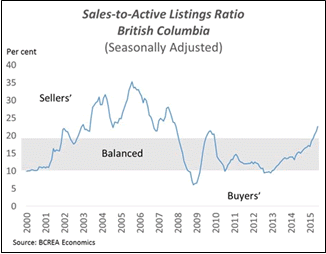
“Overall market conditions remain in relative balance in BC,” added Muir, “however, relatively fewer homes for sale have created sellers’ market conditions in some communities.”

Year-to-date, BC residential sales dollar volume was up 24.5 per cent to $28.5 billion, compared to the same period last year. Residential unit sales were up 17.2 per cent to 50,376 units, while the average MLS® residential price was up 6.2 per cent at $565,031.

1 146 147 148 149 150 220