VICTORIA, BRITISH COLUMBIA–(Marketwired – Feb. 6, 2014) – According to Canada Mortgage and Housing Corporation’s (CMHC) First Quarter Housing Market Outlook British Columbia Highlights report, housing starts in British Columbia are forecast to total 27,800 homes in 2014 and remain at that level in 2015.
“While the level of housing starts is projected to remain the same on an annual basis this year and next, expect a slight shift toward single-detached housing starts as the economy and labour market gain traction,” noted Carol Frketich, CMHC’s BC Regional Economist. “Single-detached housing starts are forecast to increase this year and next while multiple housing starts are expected to remain relatively unchanged.”
Existing home sales through the Multiple Listings Service (MLS) are forecast to total 76,000 units in 2014 and 77,300 units in 2015. The average home price is forecast at $542,500 in 2014 and $547,100 in 2015. Last year’s upward trend in the average home price is expected to lead to increased new listings in 2014. With the increased supply of existing homes for sale providing more choice to homebuyers, the average home price is forecast to grow at a pace slower than the general rate of inflation.
Click here to review the CMHC Housing Market Reports
For more information, visit CMHC.ca or call 1-800-668-2642.
I found that even though this article was written mainly for the Vancouver and Lower Mainland market area the advice that they have also applies to the Kamloops market. It is important to pick the right Realtor for you. There are a number of Realtors to choose from and it is hard to know where to start.
This article appeared on the Province website on February 7th, 2014 and was written by Michael Bernard.
With the average home selling for more than $600,000 last year in Vancouver, buying and selling real estate is a serious business where a single mistake can cost you thousands of dollars.
Those mistakes can include hiring the wrong real estate agent, so it pays to listen to the experts before you sign on the dotted line. The leaders of the two major real estate boards covering southwestern B.C. recently offered some tips on how to choose the right agent – whether you are buying or selling a home.
“You really want to know what experience the realtor has before you engage them,” said Sandra Wyant, president of the Real Estate Board of Greater Vancouver. “If you are looking to purchase a condominium in downtown Vancouver, you want to be looking for an expert in that area and in stratas.”
Wyant says friends and family can be a real help in choosing a realtor.
“They will be very honest about their experience with a realtor. And ask the realtor for references, as well.”
If you are new to Metro Vancouver or don’t have friends or relatives to ask, both boards offered ways to size up an agent you are considering.
“If you have open houses in the area you are seeking to buy or sell in,
you can pop into the open house and interview the realtor who is doing those open houses,” Wyant said. “During the interview, you might ask the realtor how many transactions they handled in the past year so you can get a good sense of their experience in the business.”
Ray Werger, president-elect of the Fraser Valley Real Estate Board, said the Internet has great tools, such as LinkedIn or Google or realtor.ca, for checking out realtors.
“I would want to know if they are a well-rounded person and what kind of person are they outside of the ‘business veneer’,” he said. “Do they work in the community? Do
they have their own website and what sort of marketing do they do and what sort of price range do they work in?” Both Wyant and Werger put a high premium on communication and listening skills when sizing up a realtor.
“Do they listen well to the questions you are asking or are they selfabsorbed and pumping themselves up?” Werger asked.
Wyant also stressed that good realtors “put your needs above their own,” something that should become obvious during an interview.
People buying or selling a home should also make sure the realtor will meet their expectations about how often they communicate with them.
Ron Todson, who is the Fraser Valley board’s current president, said that when he was active in real estate sales, some clients wanted to hear from him every few days, while others only wanted to hear when they had an offer on their home or when he had a home to show them.
Todson said he had a set system of communicating any offers or other activity to the client every Thursday and would meet the client once a month. Regardless of your communications needs, the most important thing is to make sure you are comfortable with your realtor and that the relationship is a good fit, he said.
Vancouver, BC – January 30, 2014. The British Columbia Real Estate Association (BCREA) released its 2014 First Quarter Housing Forecast Update today.
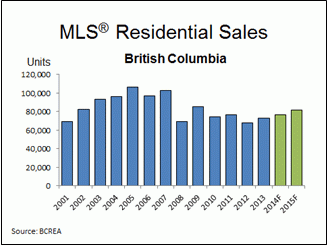
BC Multiple Listing Service® (MLS®) residential sales are forecast to increase 4.8 per cent to 76,450 units this year, before increasing a further 7 per cent to 81,800 units in 2015. The five-year average is 75,400 unit sales, while the ten-year average is 84,400 unit sales. A record 106,300 MLS® residential sales were recorded in 2005.
“Housing demand in the province has nearly fully recovered from the 2012 downturn,” said Cameron Muir, BCREA Chief Economist. “Over the next year, BC will be the beneficiary of more robust global economic growth, led by a resurgent US economy and a favourable exchange rate. The resulting boost in employment will help underpin the housing market.”
“Home prices are not expected to climb much higher than the overall inflation rate as housing starts are expected to keep pace with consumer demand, added Muir. The average MLS® residential price is forecast to increase 1.8 per cent to $547,300 this year and a further 1.7 per cent to $556,800 in 2015.
Venture Kamloops recently released this video about Kamloops and all it has to offer those who call Kamloops home. This short four minute video is a great snapshot of our city.
About Venture Kamloops:
As the economic development arm of the City, Venture Kamloops’ focus is just that, economic development. The team works to provide the most up-to-date information to those interested in starting their business in Kamloops or expanding operations into the city.
Venture Kamloops’ mission is to create economic growth to establish the city as the premiere location for business development. This is done by featuring the city’s resources and offering comprehensive information plus a full spectrum of support services to investors and entrepreneurs.
For more information about Venture Kamloops click here. You can also access their 2013 annual report through this link.

 VICTORIA, BRITISH COLUMBIA–(Marketwired – Feb. 6, 2014) – According to Canada Mortgage and Housing Corporation’s (CMHC) First Quarter Housing Market Outlook British Columbia Highlights report, housing starts in British Columbia are forecast to total 27,800 homes in 2014 and remain at that level in 2015.
 With the average home selling for more than $600,000 last year in Vancouver, buying and selling real estate is a serious business where a single mistake can cost you thousands of dollars.