Be Loyal and Don’t Shop: A Recipe for Overpaying for your Mortgage

This informative article appeared on CanadianMortgageTrends.com on September 30th, 2012 and was written by Rob McLister, CMT.

Big banks love mortgage consumers who don’t carefully comparison shop. They also enjoy capitalizing on their “home bank” advantage with existing customers. The article that follows examines recently-released research on these topics. It’s a revealing look at how big lenders benefit significantly from things like mortgage “search costs” and customer “switching costs.”

“Search costs” refer to the time, skill, money and effort required to find a better mortgage deal. “Switching costs” represent the expense of moving to a new lender.

The findings below come from a brilliant Bank of Canada research paper by Jason Allen, Robert Clark and Jean-François Houde. It’s chock full of insights into why mortgage consumers pay higher rates than they have to, and why being loyal to a lender can cost you.

The key findings of this research are summarized below. If you don’t have time to read them all, focus on the underlinedparts. CMT comments appear in italicized text and after the “Observations” labels. All quotes are taken directly from the study.

Consumers aren’t created equal:
Research shows that there are major differences in people’s:

  • “Degree of loyalty to their main financial institution.”
  • Ability to “understand the subtleties of financial contracts”
  • Ability and willingness to “negotiate and search for multiple quotes”

Canadians generally don’t consider all available mortgage alternatives.

Hunting for a better mortgage:

  • Many borrowers simply do not work as hard to “search” for a better mortgage. That’s largely because of the effort they “must put forth when gathering multiple quotes.”
  • Inadequate mortgage research induces “profits for lenders” and “permit(s) them to price discriminate between consumers.” (It also raises your chances of getting stuck with bad mortgage terms.)
  • The average markup is estimated to be 4.1% for non-searchers and 1.9% for searchers, but the distribution is much more skewed for searchers with close to 25% of [comparison shoppers] facing zero markup (above the marginal cost).”
  • In the past, “approximately 25% of borrowers [paid] the posted rate.” (This was based on data from more than a decade ago. The numbers are not as high now, especially for well-qualified borrowers. That said, there is no data to confirm how many people actually pay the posted rate today.)
  • “…Consumers dealing with [large] institutions pay more on average for their mortgage.”
  • Not surprisingly, the decision to switch lenders is “correlated with” the borrower’s willingness and ability to search for a better deal.
  • “The fraction of ‘switchers’ is significantly larger” for:
  • New homebuyers (i.e., former renters or [those] living with their parents), and for
  • Broker customers (Lenders love to get their hands on first-time buyers, and it’s a big reason many are happy to pay brokers to deliver those customers.)
  • “Consumers financing larger loans…are more likely to search (and pay lower rates).” In turn, they have a higher “switching probability.”
  • “Richer households have a higher value of time, and therefore higher search costs on average.” (…and many of them needlessly overpay.) In short, they have less tendency to switch lenders.
  • “…About 30% of consumers only consider dominant lenders.” (Usually a big mistake.) “For these consumers, the average number of lenders drops to three, which can significantly increase the profit margin of banks.”

“Home Bank” advantage:

  • Everything else equal, a customer’s home bank usually gets their mortgage business. This is akin to a home field advantage in sports. (“Home bank” can also refer to a client’s “home lender.”)
  • Even when all is not equal, the home bank often wins. That’s partly because consumers are “motivated by more than just price.”
  • The study’s authors estimate that consumers are willing to pay “between $759 and $1,617 upfront ($13.80-$29.40 per month) to avoid having to switch banks.” (Many will pay more because they can’t quantify the value of lender differences. Case in point are mortgage penalties, which most people can’t measure until it’s too late—when they have no choice but to break their mortgage and pay whatever they’re quoted.)
  • Put another way, “lenders directly competing with [a client’s] home-bank will on average have to discount the [mortgage] by a margin equal to the switching cost in order to attract” a new customer.
  • The study finds that “loyal consumers pay on average nearly 9 basis points above the rate paid by switchers.” (It’s no coincidence that many borrowers choose to stay with their existing lender when a competitor’s rate is better by less than 10 basis points.)
  • Not surprisingly, “the market for ‘non-loyal’ consumers is very competitive”

Factors that support customer loyalty to their home bank include:

  • Proximity to a local branch
  • Better access to lending terms
  • Association with a strong recognizable brand
  • Consolidation of accounts (for convenience)
  • Lower chequing account fees, higher savings rates and other perks (Bank and credit union reps commonly use these perks to counter customer objections to higher mortgage rates. To some extent, free banking, banking comparison sites and modern-day electronic funds transfers are reducing the allure of these home lender “freebies.”)
  • The cost and effort of switching bank accounts to a new lender (It isn’t necessary to have your mortgage and bank accounts at the same lender, but some people believe it’s important.)

Observation: The data used in this study is 11-13 years old. There is no way to know how much the home lender advantage has changed in that time. Various factors have altered this advantage over the last decade, including:

  • Rate comparison sites — which make it easier to know when your lender isn’t being competitive
  • More broker competition — Brokers reduce consumers’ search costs by assisting them with comparison shopping and offering comprehensive advice not biased to one lender. (Although, it should be noted that in most cases 90% of a broker’s volume is routed to three lenders, so there can be bias there as well.) “Unlike in the United States, brokers in Canada have fiduciary duties…The average discount that a mortgage broker can obtain for a borrower is about 20 basis points, or approximately $16 per month on a $140,000 loan.” (It’s likely lower now as this data is old.)
  • Electronic banking — Many consumers want a mortgage that’s integrated with their banking. That plays right into the hands of deposit-taking lenders. Today, however, one can link different institutions’ mortgage accounts and bank accounts and electronically move funds between them with ease.
  • “In 2004, 80% of new borrowers…contacted their main financial institution when shopping for their mortgage.”
  • The research shows that, depending on the year, “nearly 60% of new home-buyers remained loyal to their main institution.” (CMHC’s Mortgage Consumer Survey finds that 88% of renewers remain loyal to their existing lender.)
  • “…Only 35% of consumers dealing with brokers remain loyal to their home institution
  • 73% of households choose a lender with which they already have a prior financial relationship. The study authors estimate that “72% of consumers have a positive home (bank) bias.”
  • “67% of Canadian households have their mortgage at the same financial institution as their main checking account.” (Having your bank account gives a bank an enormous advantage. Some have even been known to scan customer chequing accounts to see if they’re making a mortgage payment to another lender. The bank then contacts them ”out of the blue” to solicit their mortgage business.)
  • Banks are more likely to transact with customers who are not motivated to search as hard. (These customers are low-hanging fruit for the banks.)

Home bank tactics:

  • Bank_Status“Lenders…are open to haggling with consumers based on their outside options.” (We all know that, right?)
  • “This practice allows the home bank to price discriminate by offering up to two quotes to the same consumer: (i) an initial quote, and (ii) a competitive quote if the first one is rejected.” (Savvy well-qualified consumers routinely reject their lender’s first quote.)
  • Lenders know that “low risk and wealthy consumers represent lower lending costs.” For that reason, lenders offer “lower rates on average” to these borrowers.
  • The loan sizes and credit scores of consumers are particularly strong predictors of the rates they pay.”
  • Lenders know financially constrained consumers have fewer options. These people “pay on average a premium equal to 14 basis points.”

Stats of note:

  • At the time of this study, the “Big 8” (Bank of Montreal, Bank of Nova Scotia, National Bank, Canadian Imperial Bank of Commerce, Royal Bank, TD Canada Trust, Desjardins and ATB Financial collectively “controlled 90% of assets in the banking industry.”
  • “Interest and fees generated from mortgages represent approximately 21% of total revenue for the largest banks.”
  • “80% of new homebuyers require mortgage insurance.”
  • This is the distribution of mortgages between a client’s main and secondary financial institutions:

Account                 Main FI    2nd FI   All other FIs
Mortgage (all)            67.4%     10.9%      21.7%
Mortgage(no broker)  70.3%     10.8%      18.9%
Mortgage (broker)      37.3%     30.6%      32.1%
Source: Canadian Finance Monitor survey conducted by Ipsos-Reid, between 1999 and 2007.

  • “On average, borrowers pre-pay an additional 1% of their mortgage every year.”
  • “Richer households are more likely to pre-pay their mortgage, which reduces the expected revenue for lenders.”
  • “The (mortgage) transaction rate is on average 1.2 percentage points above the 5-year bond rate” but varies widely.”
  • “The standard-deviation of retail (mortgage) margins is equal to 66 basis points.”
  • At the time of the study, “80% of consumers transacted with a bank that has a branch within 2 kilometres of their new house” (In the electronic banking age, lender location has taken on less importance. Tens of thousands of customers now choose lenders located nowhere near their home—often in a totally different province.)
  • Here’s an interesting finding from the U.S.: “Hall and Woodward (2010) calculate that a U.S. homebuyer could save an average of $900 on origination fees by requesting quotes from two brokers rather than one.”

Miscellaneous Findings:

  • It is “unlikely that the posted rate is used to attract new customers,” say the authors.
  • But why are posted rates still in existence? Well, the report states: “Banks have an incentive to post an artificially high interest rate that is not binding. Indeed, the pre-payment penalty is…evaluated at the posted rate valid at the signature date, rather than the (actual) transaction interest rate. Banks therefore have an incentive to raise the posted rate, in order to reduce their pre-payment risk.” (Many discount lenders—particularly broker-only lenders—don’t play these penalty games. They base your penalty on the actual rate you pay, which is much more fair than the big banks’ method of using posted rates.)
  • “…Lenders can incur transaction costs in the event of default, therefore lowering the expected revenue from risky borrowers.” When a borrower defaults, lenders also face “lost revenue from complimentary products like other loans and saving accounts.” Hence, contrary to charges by many housing critics, mortgage insurance does not eliminate a lender’s risk. (For more on this see: Skin in the Game)

Implications of this data
Those of us who see borrowers overpaying on a regular basis know how important it is to compare mortgage options. But it’s interesting to hear the repercussions of not doing so, as articulated by a reputable academic source.

These findings should stick in regulators’ minds, especially as they contemplate policies that:

  • discourage price discrimination
  • support greater access to funding (via securitization) to promote lender competition.

Allen, Clark and Houde note that “policies designed to increase information about the market, (mortgage) contracts, or the availability of different lenders would be beneficial to consumers.” A good example of this is the Department of Finance’s penalty disclosure initiative—for which it deserves big applause.

Similarly, the authors conclude: “policies that encourage consumers to consider lenders other than their main financial institutions would reduce overall market power.”

About the Data: It’s important to note that this study’s data was comprised only of high-ratio insured mortgages arranged in branches between 1999 and 2001; It did not include brokered mortgages, very big or very small mortgages, applicants with extremely high or extremely low incomes, or conventional (uninsured) mortgages.

If you’re interested in more research about mortgage pricing, see: Getting the Best Mortgage Rate.

BC Home Sales Continue to Trend Lower, BCREA

Vancouver, BC – September 17, 2012. The British Columbia Real Estate Association (BCREA) reports that the dollar volume of homes sold through the Multiple Listing Service® (MLS®) in BC declined 25.4 per cent to $2.6 billion in August compared to the same month last year. A total of 5,337 MLS® residential unit sales were recorded over the same period, down 17.9 per cent from August 2011. The average MLS® residential price was $491,145, 9.0 per cent lower than a year ago.

Real Estate Statistics BC MLS Sales

“Consumer demand continued to trend lower in August,” said Cameron Muir, BCREA Chief Economist. “Tighter mortgage credit conditions introduced in July appear to be taking a toll on an already tentative market. However, with home sales slower than improving economic conditions suggest, a rebound may be in store before year-end.”

Year-to-date, BC residential sales dollar volume declined 17.5 per cent to $26.2 billion, compared to the same period last year. Residential unit sales dipped 9.1 per cent to 50,131 units, while the average MLS® residential price was 9.3 per cent lower at $521,599.

Kamloops and District Real Estate Associations Statistics For August 2012

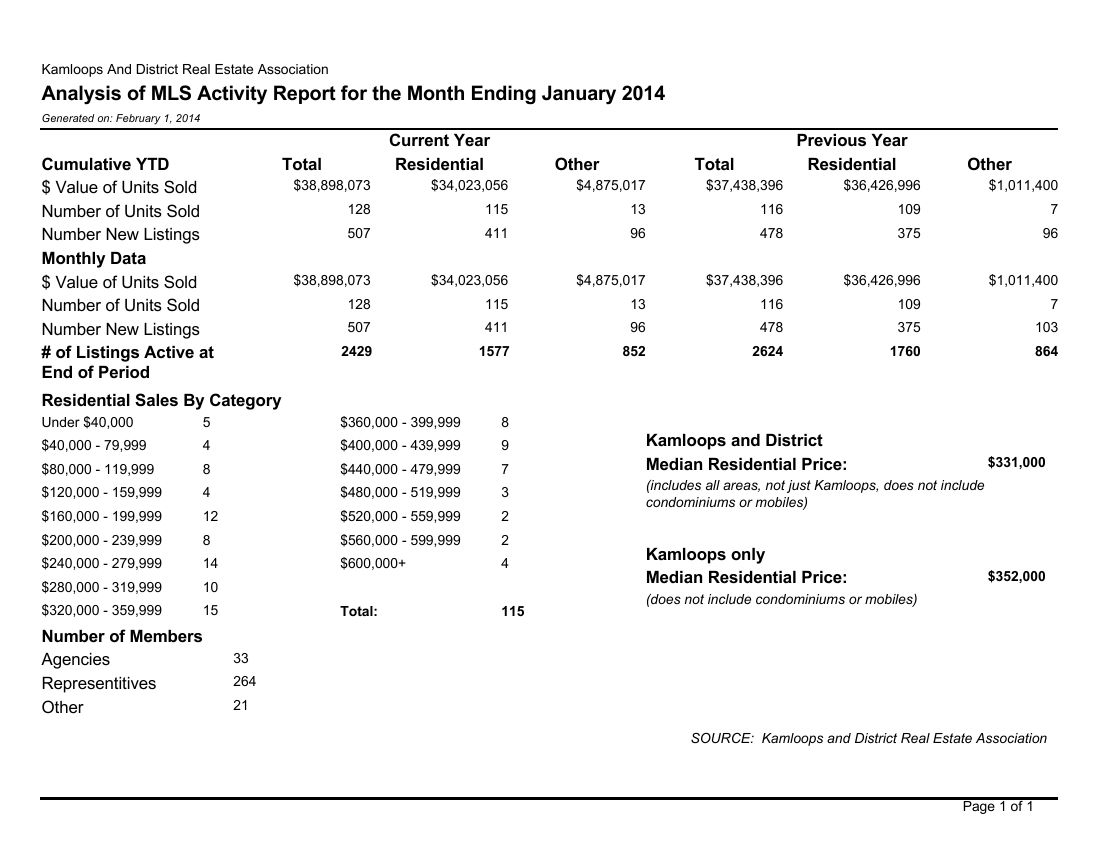
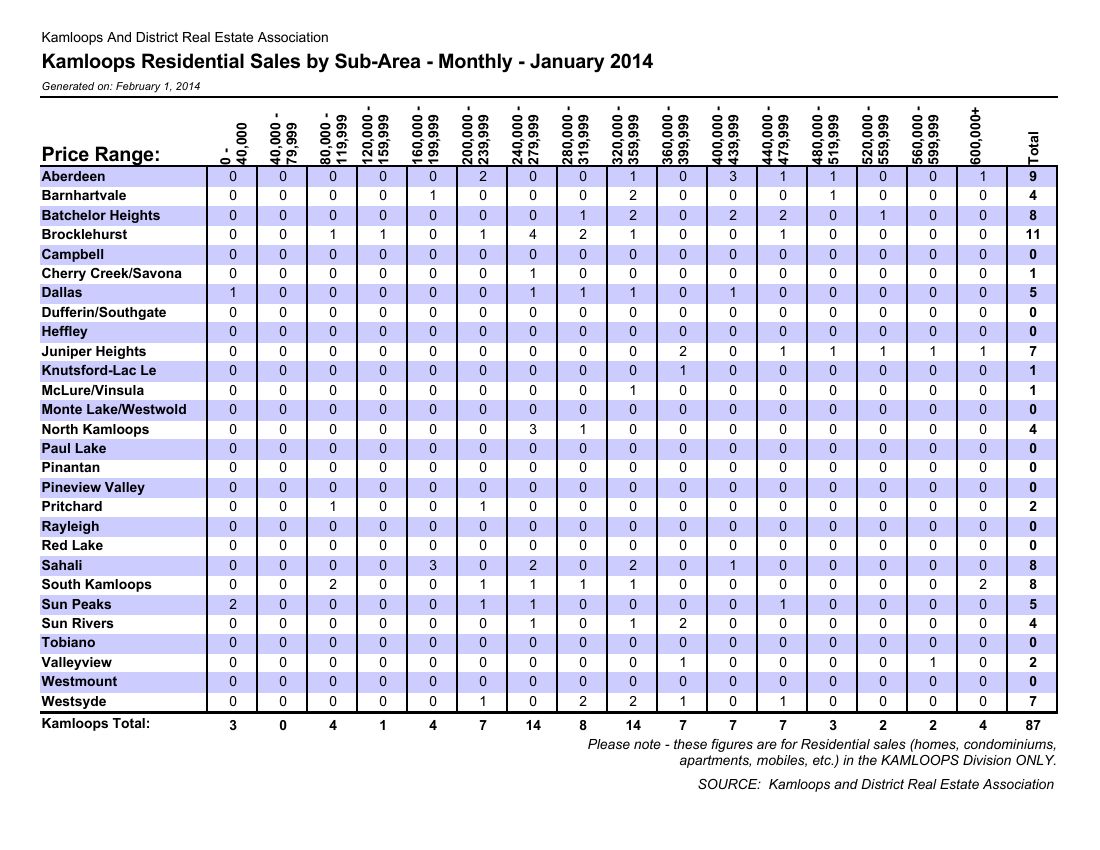
The Kamloops and District Real Estate Association has released it’s latest statistics for August 2012. Click on the image to enlarge.

Kamloops BC RealEstate Statistics August 2012 Comparative Analysis

Kamloops BC Real Estate Statistics August 2012 Comparative Analysis


Kamloops BC RealEstate Statistics MLS Activity August 2012

Kamloops BC Real Estate Statistics MLS Activity August 2012


Kamloops BC RealEstate Sales Statistics by Subarea August 2012

Kamloops BC Real Estate Sales Statistics by Subarea August 2012


CHMC Presents Revised Forecast For Canada’s Housing Market 2012-2013

This article appeared on DailyMarkets.com on August 19th, 2012 and was written by

Canada Mortgage and Housing Corp presented its latest forecast for Canada Housing market on Tuesday 11th August. The report focuses on market trend and condition for the rest of 2012 and 2013. The CHMC’s outlook for the third quarter of this year proves that the market is cooling all across the country and the slowdown will continue throughout 2012 and 2013.

The forecast is largely based on statistics and data collected and compiled by Canada Real Estate Association CREA.

Mortgage Expert, Marcus Arkan, CEO of Syndicate mortgages has said that CHMC’s report confirms what analysts and economists have been saying ever since new mortgage rules were announced. He said, “Since the very day new mortgage rules were announced, the tabloids are filled with speculations and expectations. Most of experts including CHMC itself were warning about a slowdown. Now with the latest stats and figures before us, CMHC has finally confirmed our worst fears.”

According to CHMC, the slowdown will not create a major economic threat but send the market in a more balanced situation for a year or so. The report indicates that the market has shown sustained activity levels for the first two quarters of this year. Due to this sustained growth, there will be a definite slowdown in price growth.

Mr. Arkan highlighted how the latest forecast is slightly different than what CHMC has predicted in June. “The point forecast regarding housing starts in the latest report is higher than what has been predicted in June and the range is slightly wider. This may be because the data and stats from July have provided a far more clear idea of where the market is heading now.”

For 2012, CHMC’s numbers predict that the range of housing starts will remain 96,800 to 217,000, with a point forecast of 207,200 units. For the next year, starts are expected to be in the range of 73,000 to 207,400 units. Similarly, existing home sales will also remain within a moderate range of 442,300 to 485,200 units in 2012, with a point forecast of 466,600 units this year. For 2013, these sales are expected to increase up to 487,600 units.

One thing that Mr. Arkan pointed out as the most interesting part of the CHMC’s latest report is the prediction regarding prices for property sales. The report suggests that the slowdown will not lead to price decline. However, the rate of price growth will slow down to some extent.

According to CHMC’s report from last month, the point forecast for average price was $372,700 for 2012 and $383,600 for 2013. Now according to the latest forecast, the average price shall remain lower at $368,000 for 2012 and $377,300 for 2013.

To view CMHC’s market forecasts, reports and analysis click here.

1 162 163 164 165 166 224