
Kamloops Building Permits and Property Sales Higher In July 2009

This article appeared in the Wednesday, August 12, 2009 edition of the Kamloops This Week and was written by Jeremy Deutsch.
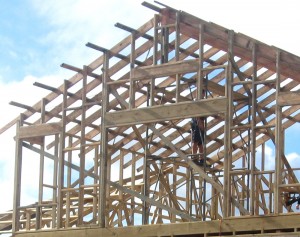
Construciton - framing Kamloops HousingJust as the economy is starting to show signs of life, construction in Kamloops also appears to have been given a new ticker. For the second straight month, the number of issued building permits and their dollar values increased. In fact, the number of single-family permits issued for the month of July was more than the previous two months combined.

A total of 24 single-family residential permits were issued in Kamloops, making it a bigger month than July 2008, when 15 permits were handed out. Throw in another 88 multi-family units and the number of residential permits climbs to 112 – more than double the previous July. The value for all those permits added up to $17 million, which was more than in July 2008.

Though the commercial side – which had been strong throughout the year – did take a dip, the total value of construction permits for the year now sits at $72 million. That’s well short of the $122 million at this time last year, but on pace for the $120 million to $140 million projected for 2009.

The real estate market in the city was just as busy. According to the Kamloops and District Real Estate Association (KADREA), 264 residential units were sold in the city last month, marking a 14 per cent increase from July of the previous year. Of the units sold, 82 per cent were under $400,000. Craig McIntyre, president of KADREA, attributes the bump in sales to a number of different factors, including good selection on the market, reasonable pricing and low interest rates.

Though the market in the first half of 2008 was thought of as still being red hot, McIntyre pointed out sales were already trending downward before the global recession hit last fall. As for the future, McIntyre predicts sales to stay strong for the rest of the year, noting the peak months are in the spring and fall. While he suggested the market is on the cusp between a buyer’s market and a balanced market, McIntyre said it’s still a good time to buy. “Kamloops remains a good place to be.”


Link

Report On Kamloops 2009: Uplifting View Of The Downturn

This was published by the Kamloops This Week in their 2009 Progress Report that was distributed March 29, 2009. Peter Milobar, the Kamloops City Mayor wrote this piece in the publication calling for residents to take a “realistic and positive” view on the economy in Kamloops. He does put some of the facts about the recent downturn in building permit values and real estate house values into perspective. Read below for the full story.

Peter Milobar Kamloops Mayor 2009

Peter Milobar Kamloops Mayor

Over the next year, keeping things in perspective will be critical as it seems we are being inundated daily with stories of economic ruin. While times are undoubtedly changing quickly and the overall economy is slowing, keeping the numbers we see in perspective is important.

Headlines highlight drops in building permit values or house values seem bad at first, but let’s put some perspective to those numbers. This year, our development services department is anticipating building permit values of around $140 million. Now one could say, based on the 2008 number of $208 million, this year will see a 30 per cent drop in values. Technically, that is correct, but does it mean the construction industry is on life support? To put some perspective to the numbers, you would see 2008 was the third consecutive record year for permit values. Yet a closer look to the projected 2009 numbers will show both 2003 and 2004 actually had lower permit values and in fact, $140 million is the 10 year average for Kamloops. So any drop from a record year would seem big. When you consider many of the projects in the 208 permit value numbers will actually be constructed this year and the fact builders were having trouble finding workers under the record setting years, the construction employment numbers should stay strong.

Two other bright lights right now are the B.C. Lottery Corporation and Thompson Rivers University. Locally, the BCLC is currently undergoing not only significant renovations, but are also in the process of hiring 60 new employees. TRU and the newly announced Faculty of Law are continuing to help make Kamloops an even more diversified economy. Domtar and their announcement of new capital improvements for their boilers is also a good indicator of the long-term viability of the Kamloops and regional economy. Capital re-investment provides not only much needed dollars into the economy, but – perhaps more importantly – provides reassurance to the many employees and suppliers of Domtar.

We have been hearing for some time now about the impending labour shortage heading our way into the next three to five years. Slowing economy or not, people will still be getting older and as RRSP accounts start to recover, retirements will pick up, resulting in new job opportunities.

None of the above is meant to make light of the situation the world economy is in and are only examples of how, when most forms of business are coming off record years of growth, some contraction is inevitable. Moving forward, there are two ways to have a realistic view on the economy – a realistic and positive view or a realistic and negative view. My choice is the realistic and positive view. What view will you chose over the next year?

The City Of Kamloops Is Finding Ways To Keep Home Owners Moving On Renovations

Kamloops Home Renovations“Getting Down To Business. Mayor and business groups continue meeting to find ways to keep the city moving.”  Written by Jeremy Deutsch of The Kamloops Daily News.  Here is a portion of the story about home renovations and the changes Kamloops City Permits Office has made to the approval process.

A second meeting of the business minds in Kamloops has led to changes in the city’s permit process. The city is working to shorten the time it takes to hand out a permit for small interior renovations to one day. In a typical renovation situation, the applicant submits the appropriate forms, but it can take up to a week to get approval by the time the building department looks at the site.

Under the new system. The applicant will go to the city with a detailed plan for the renovations An inspector will go through the plan then give it an initial OK. The renovations can begin immediately, with a building inspector giving the final OK after inspecting the site once the work is done.

The Canadian Home Builders’ Association (CHBA) Central Interior saw the delay as a major issue for it’s members, saying that a lot of people get discouraged from taking on renovations when they have to wait for approval.  They suggested the longer the wait, the greater the prospect of the builder losing a job.

Economic Uncertainty Drives Real Estate Plunge Across Lower Mainland

I found this article on the Vancouver Sun’s website today. Provincially the real estate market is feeling the squeeze. The Sun reported that real estate sales are down 58% in the Lower Mainland. In Kamloops, the Kamloops and District Real Estate Association released it’s January statistics and our board is reporting 64% drop in residential sales for the month of January. Read below for the full story, it is focused more on the Lower Mainland, but keep in mind our market is not so different here in Kamloops. We are affected by some of the same economic factors that the Lower Mainland is affected by.

Home sales at lowest point since early 1980s, according to reports

Real estate sales across the Lower Mainland crawled along in January, real estate boards reported Tuesday, with consumers reluctant to buy during recessionary times and with expectations that prices will continue to decline.

In Metro Vancouver, Realtors recorded 762 Multiple-Listing-Service sales in January, down 58 per cent from the same month a year ago, and the so-called benchmark price for a typical detached home down 11 per cent to $659,638 compared with January of 2008.

In the Fraser Valley, Realtors booked a similar 59-per-cent decline in sales at 359, and the so-called benchmark for a typical single-family home down 9.6 per cent from the same month a year ago.

Both the Real Estate Board of Greater Vancouver, which covers most of Metro except Surrey, and the Fraser Valley Real Estate Board, which takes in Surrey and White Rock, said sales were at levels not seen since the early 1980s.

“We’re seeing the same factors at play: uncertainty in people’s minds about where the economy is going and where their jobs are going,” Robyn Adamache, a market analyst with Canada Mortgage and Housing Corp. said in an interview.

“As well, I think at lease some people are expecting further price reductions and perhaps are holding off on buying waiting for that to happen.”

The B.C. Real Estate Association on Monday released its latest forecast that predicted prices will decline 16 per cent in Metro Vancouver over 2009.

Adamache added that January is traditionally a slow sales month and not a month that can be used to gauge how the year will go, but “we’re sort of well below [sales levels] we’ve seen in previous Januarys.”

Both real estate boards also saw inventories of unsold homes decline in January. In Metro Vancouver, covered by the Greater Vancouver board, January new listings were down 30 per cent to 3,700, and current active listings of 13,966 are down 6,000 from October.

However, Adamache said that sales have slowed so much that the months of supply in unsold inventory has crept up to 11 months, the highest it has been in 10 years.

She added that the ratio of sales to new listings has dropped to a level that has not been seen since at least 1984, the first year for which she has records.

In the Fraser Valley, total inventory of unsold homes in January stood at 8,630 units, 26 per cent higher than January 2008, but 30 per cent lower than the record high inventory recorded last September.

Tsur Somerville, director of the centre for urban economics and real estate at the Sauder School of Business at the University of B.C., said it will be later in the year before we know how much the market is still declining, or whether there has been any stabilization.

The reason, Somerville said, is because the year-over-year comparison is with a month that had relatively high sales, and the dramatic drop-off in Vancouver’s markets did not begin until later in the year.

“I think we’re still declining just because the [sale decline] is 60 per cent versus 40 to 50 per cent,” Somerville said in an interview, “but we won’t get a sense of how much and at what rate until later.”

Dave Watt, president of the Real Estate Board of Greater Vancouver, said the last 10 days of January did see realtor showings and sales pick up relative to the beginning of the month.

Watt said the buyers in the market are “back to looking for a home to purchase and are very much thinking long term.”

1 11 12 13 14 15