I recently returned from the Natural Resources Canada ecoEnergy Adviser training in Saskatoon. Being an ecoEnergy Adviser means that in addition to doing home and commercial property inspections in Kamloops and the interior I will also be performing the energy evaluations that help people to access all the government grants and incentives now available.
This program is really a wonderful opportunity for people to upgrade their real estate holdings with more energy efficient furnaces, air conditioners, heat pumps, tank less water heaters (hot water on demand), improved insulation, new windows, low flush toilets and a whole host of other EnergyStar products. The benefit is some of the costs will be offset by the provincial and federal governments. It’s win win – you help the environment, save yourself a bunch of money in heating and cooling costs, and the government helps you pay for it.
This program is available to both home owners and renters of single family homes, townhouses, and low rise multifamily homes. You don’t even have to live in the house to qualify for the grant, it’s open to landlords as well.
For more info on the program and the combined BC and Federal grants go to the LiveSmart BC website. Also, CMHC insured homes are eligible for a 10% mortgage insurance refund when they meet certain ecoEnergy targets. See the CMHC website for further information.
Don’t forget this money is over and above the federal home renovation tax credit that can earn you up to $1350 back on your tax return. With all these programs in place, there has never been a better time to renovate your home here in Kamloops. All these energy saving renovations are beneficial to both home owners wanting to stay in their home long-term and home owners selling their home. These upgrades will really help showcase your home and make it much more attractive to potential buyers in a very competitive real estate market.
Todd Hrycenko, Global Property InspectionsPhone: 250-371-2787 [email protected]
The Kamloops area has a number of recreational properties and lakefront real estate. There are many lakes surrounding the Kamloops area: Adams Lake, the Barriere Lakes, Heffley Lake, Knouff (Sullivan) Lake, Lac Le Jeune, Logan Lake, Nicola Lake (Merritt), Paul Lake, Pinantan Lake, the Shuswap Lakes and Stump Lake.
Adams Lake: This beautiful lake is located 55 minutes north east of Kamloops or 30 minutes north of Chase. Adams lake is a very large sprawling lake where many visitors enjoy cycling, windsurfing, water skiing, wake boarding, swimming, canoeing and fishing. Many fish for kokanee and rainbow trout in this lake.
There are a number of properties on this popular lake often found on Agate Bay Road, Rawson Road and Holding Road. There is a large provincial park on Adams lake with basic campground facilities.
East and North Barriere Lakes: East and North Barriere Lakes are located 50 minutes north east of Kamloops and 15 minutes from Barriere city centre. North Barriere Lake is less developed than it’s neighbour East Barriere. To reach each lake you travel on a maintained gravel forestry service road. East Barriere is approximately 5 km of dirt road travel and North Barriere is over 20 km depending on the final destination at the lake. Both lakes are quite sought after for summer visitors, East Barriere has a small forestry campsite while North Barriere has a recreational site with a few more services. Each lake has a public boat launch for access. These lakes do allow power boats for wakeboarding, surfing, tubing and skiing. Due to their high altitude they tend to get a decent amount of snow in the winter allowing for great winter enjoyment.
To view available listings at Adams Lake, North Barriere Lake and East Barriere Lake click here.
Little & Big Heffley Lakes: These lakes are very popular because of their close proximity to both Kamloops and Sun Peaks resort. There are recreational properties on both Big Heffley Lake and Little Heffley Lake. Little Heffley lake does not allow power boats for water skiing or wake boarding as it is quite small. Big Heffley Lake does allow power boats which makes it a very popular destination for the summer months.
There are a number of homes on Big Heffley as well as acreage properties that are minutes from the lake.
Knouff (Sullivan) Lake: This lake is 40 minutes north of Kamloops and 30 minutes from the Sun Peaks Resort. Knouff or Sullivan lake is a quiet area where many recreational activites are enjoyed year round.
This lake is more of a fishing lake. Water sports such as tubing and waterskiing are not commonly done on this lake due to the size. There are a number of waterfront and semi-waterfront properties on this lake.
Lac Le Jeune: Lac Le Jenue is located 25 minutes west of Kamloops, 30 minutes east of Merritt and 15 minutes south of Logan Lake. This lake is located off of the Coquihalla Highway making it easily accessible during all seasons. Lac Le Jeune is 392 acres and is stocked with rainbow trout. There are two resorts on this lake, numerous seasonal homes and also year round residences.
The Lac Le Jeune Resort offers accommodations to accommodate all group sizes. They also host events, weddings and retreats.
To view properties and homes for sale on Lac Le Jeune click here.
Logan Lake: This small lake is located 30 minutes outside of Kamloops and 40 minutes from Merritt. Logan Lake is a small community that has many services and amenities for it’s residents including numerous shops, restaurants, an elementary and secondary school. There are a number of winter and summer activities to enjoy such as golf, fishing, cross country skiing, snowmobiling, dirt biking, hiking and paddling to name a few.
For more detailed information about Logan Lake properties for sale click here.
Nicola Lake: This lake is located in Merritt (10 km from city centre), and 45 minutes south east of Kamloops. Nicola Lake is a very large lake covering 15,351 acres. There are a lot of rainbow trout and kokanee for those who enjoy freshwater sports fishing. Windsurfing, canoeing, wake boarding, water skiing, fishing, hiking, horseback riding and mountain biking are a few of the popular activities enjoyed around this lake.
There are a number of lots and homes that are located on the waterfront.
To view available properties for sale on this lake click here.
Paul Lake: Paul Lake is located 15 minutes east of Kamloops. Paul lake has numerous residents that are seasonal and year round. There are a number of townhouses (Deerwood on Paul Lake) and single family homes on the lake. Many of the single family homes and private properties on Paul Lake are leasehold properties which the Kamloops Indian Band leases out for 25 year terms.
There are a few properties that are not located on leasehold land, but tend to be more expensive than the leasehold homes. There are a lot of activities to enjoy such as hiking, water skiing, wake boarding, fishing, swimming and paddling.
To view the current MLS listings for Paul Lake click here.
Pinantan Lake: Pinantan Lake is 25 minutes north east of Kamloops and 5 minutes past Paul Lake. The lake itself is two parts, Big Pinantan and Little Pinantan. The lake is 68 hectares in size. Pinantan properties are freehold properties not lease land. Only electric powered boats are allowed on the lake. Fishing and swimming are permitted in Pinantan lake. There are also hiking trails and other outdoor activities in and around the area to enjoy year round.
There are often many properties for sale in Pinantan, lots, log homes, small acreages and lakefront homes.
Click here to find out more about properties for sale in this area.
The Shuswap Lakes: Shuswap Lake is a very large lake network with numerous arms reaching a number of cities in the Interior. Shuswap Lake is named after the Shuswap Indians an Interior Salish tribe. This lake is the largest lake in the area with hundreds of kilometers of shoreline with hidden coves and beaches. Little Shuswap extends off of the north western arm of the main arm of the Shuswap lake. The cities and communitites that surround the shoreline of this lake include Salmon Arm, Sicamous, Chase, Seymour Arm, Balmoral, St. Ives, Blind Bay, Carlin, Magna Bay, Scotch Creek, Eagle Bay, Notch Hill, Skimikin, Anglemont, Celista, Lee Creek, Sorrento, Sunnybrae, Canoe, Tappen, White Lake and Wild Rose Bay.
Real estate in and around the Shuswap lake area is very popular for both year round and seasonal residents. There are a lot of beautiful building lots, apartments, townhomes, single family homes and estates that surround this large lake system. Since this area is so large there are often a lot of properties to choose from. Shuswap Lake has many summer cabins that sit on the desirable waterfront but not all areas are serviced by sewer and hydro.
Click here to view homes, properties and lakefront real estate in the Shuswap Lake area.
Stump Lake: This lake is a smaller lake situated between Kamloops and Merritt on the Old Merritt Highway #5 and is 780 hectares or 1,927 acres in size. There are rainbow trout, brook trout and kokanee in this lake. This lake is relatively quiet during the summer months. Stump Lake does have public access to the lake to launch a boat or have a summer picnic. Stump Lake has a number of homes around the shoreline and in the surrounding hills.
Many of the properties here are very peaceful, set in the wilderness and have beautiful views of the lake valley.
To search for recreational properties, lakefront homes and real estate in and around the Kamloops area click here.
Do you have questions about recreational properties in the Kamloops region? We can help! We have sold a number of recreational properties all over our region. Reach out with any questions you have!
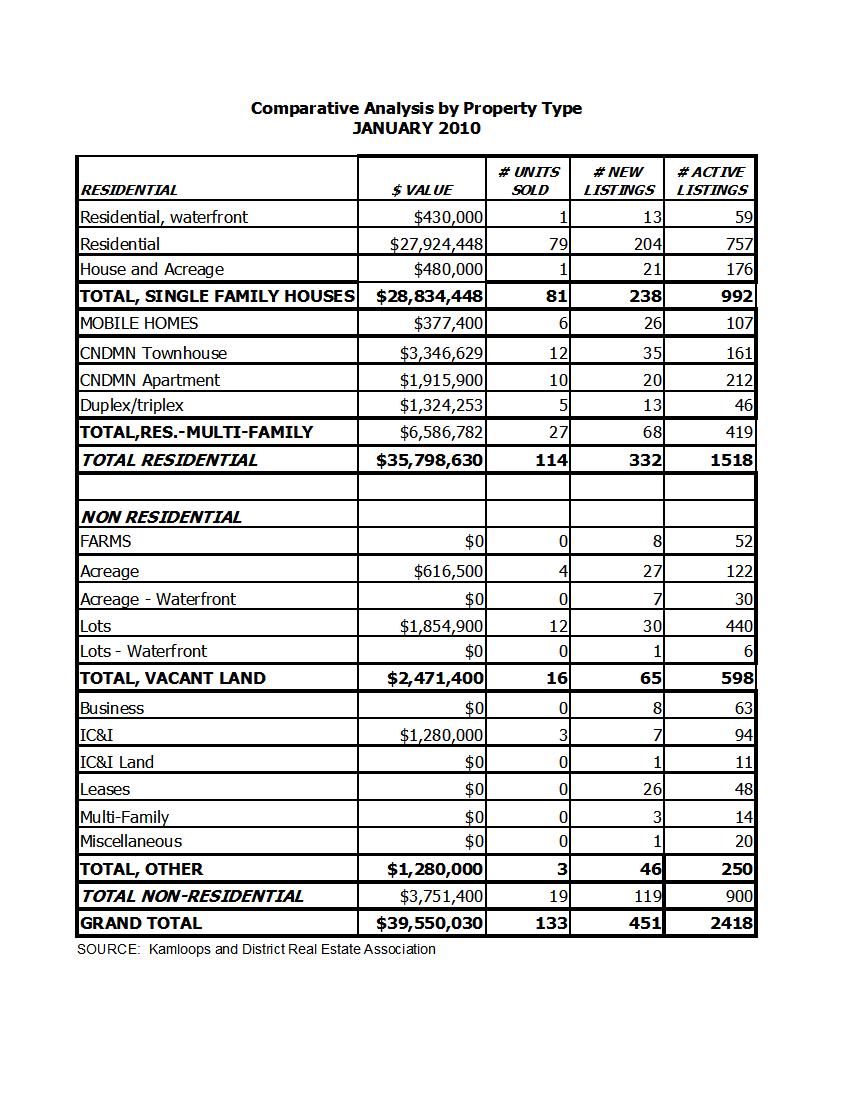
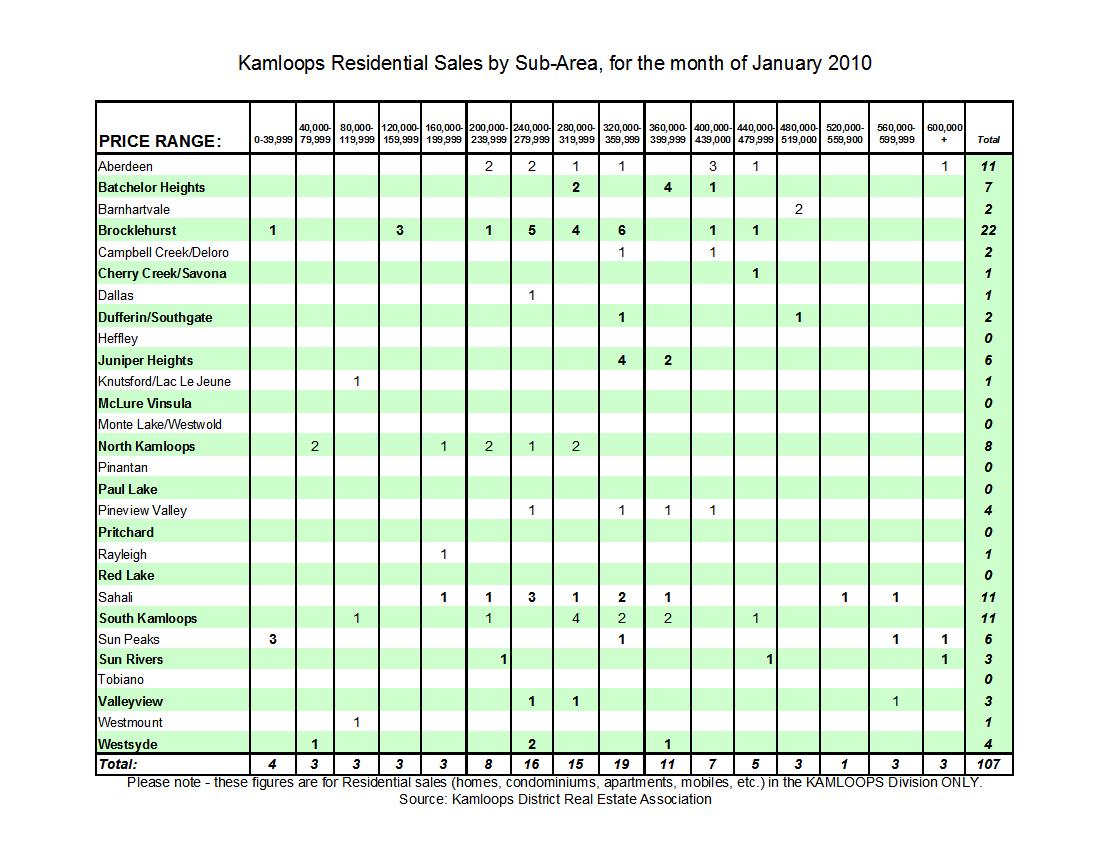
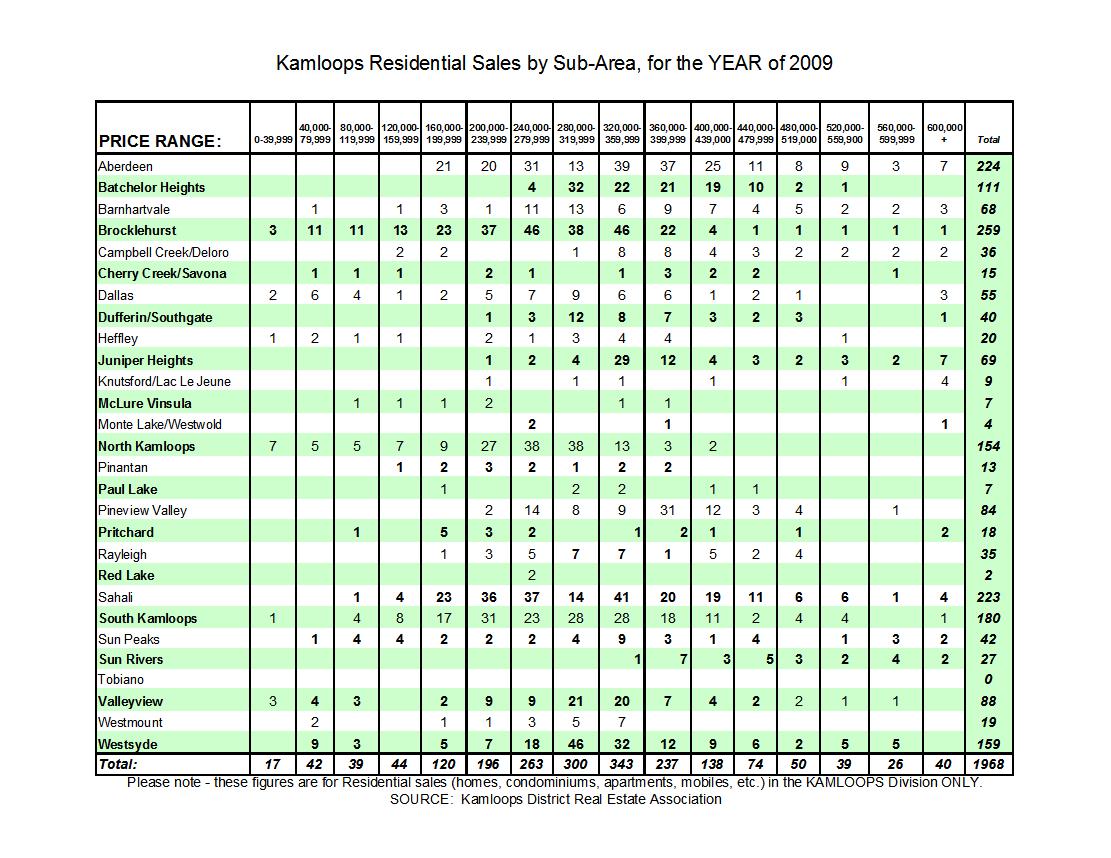
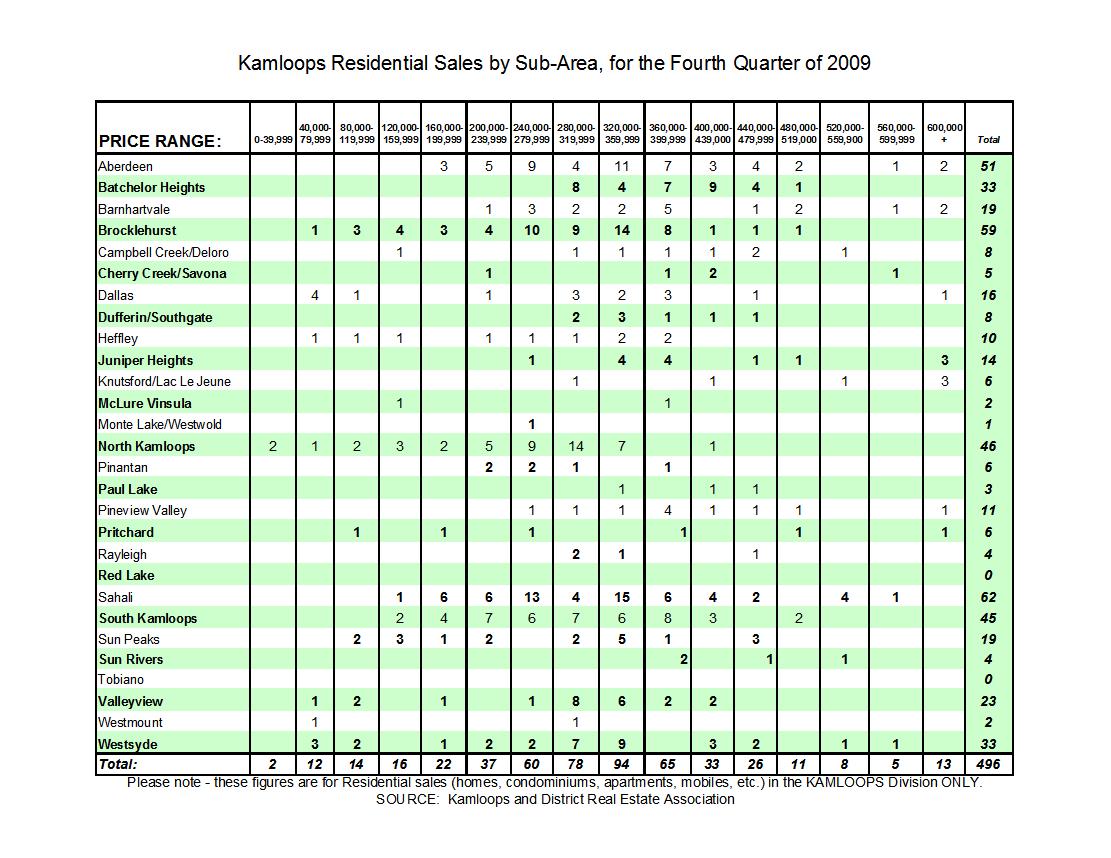
Here are the Kamloops and District Real Estate Association latest statistics for April 2009. Sales are up this month in comparison to the past few months. However, an increase in sales is common for this time of the year. Click on the image to enlarge.
Kamloops Real Estate Comparative Analysis By Property Type April 2009
Grow ops in BC continue to plague communities and Kamloops is not immune to this problem. Each grow operation presents many risks to the communities they exist in, such as drug traffic through the community and community safety related to this traffic. Marijuana production continues to be a multi-billion dollar industry in B.C. with thousands of charges laid against operators each year. There are endless stories of grow op busts of all sizes but the problem persists in B.C. and doesn’t seem to be slowing down anytime soon.
What is a Marijuana Grow Operation?
Marijuana Grow Ops appear in homes or outbuildings in residential, rural or commercial/industrial areas. These operations can occur in apartments, small bungalows, large multi-million dollar homes and commercial buildings. The buildings appear to be fairly well maintained and don’t look out of the ordinary however the internal structure may have received significant structural, electrical and heating system modifications that are not up to code or deemed safe.
Changes to these systems are done to replicate warm, humid climates in which hybrid plants flourish to produce high potency marijuana. Structures that were previously Marijuana Grow Ops are often unsafe for human occupancy. This is because of compromised structural and mechanical integrity, as well as hazards from mold (mould) and chemical residue.
Is there a grow op in your neighbourhood? How to identify a grow op.
(It is important to note that a positive response to some of these questions does not mean it is a grow op house and that the residents are involved in criminal activity. Please use this questionnaire as a basic guideline only.)
1. Occupants don’t appear to have regular job hours and drive expensive automobiles.
2. Dark window coverings on many windows
3. Illuminated rooms or outbuildings nearly 24 hours a day.
4. Heavy condensation on windows, lack of frost or snow on roofs of houses when others have frost and snow. Blowing curtains from fans.
5. Abnormal number of roof vents or unusual amount of steam in cold weather.
6. Extra security such as large fences or guard dogs.
7. Entry is always through the automatic garage doors and residents are always in their cars
8. Strange smell or odor coming from the home.
9. Electrical humming sounds, numerous fans and running water.
10. Unusual wiring to the exterior of the home and or the hydro meter spins at a faster than normal rate.
11. Commonly experienced localized power surges or browning. Lights often dim or appliances slow down with lack of power.
12. Avoid making any contact with neighbours.
13. Toys are often outside the home but no children are ever seen at the home.
14. Large quantities of growing equipment & supplies are seen taken into the home/outbuildings but there are no flowers or gardens at the home. Often purchased in winter months.
15. Numerous pots, soil, garden hoses and fertilizers around the property.
16. Appears to be vacant, yard poorly kept and newspapers build up at the front door.
17. Hoses run from doors and windows to the outside of the home.
18. Visitors often park down the street and walk to the home.
19. In condominiums owners move in at night, disappear for long periods of time or you never see them move in.
21. Garbage days there is no garbage ever or there is no noticeable activity in the home but a lot of garbage.
Grow ops can either be lived in or maintained by visiting gardeners. The RCMP see a lot of operations now where the whole house is used, on the other hand, sometimes only a small portion of a home is used.
How to detect a Marijuana grow operation when purchasing a home.
When purchasing a home it is important to do all the appropriate tests and inspections to safeguard your purchase. A thorough environmental assessment which includes an air quality and mold inspection should be conducted. A proper inspection for mould should be thorough and include numerous air samples (spore test) and visual inspection of the structure. These comprehensive tests will survey the air quality to identify and locate hidden pollution and mould levels indoors. These tests will identify any areas that had previous grow operations and contain abnormal levels of mould or chemical pollution. These agents alone can cause serious health problems leading to long term conditions.
A listing Realtor is required by the Canadian Real Estate Association to have a home owner fill out a Property Condition Disclosure Statement. This statement is filled out by the home owner and requires a home owner to disclose any “material latent defects” such as a grow operation that cannot be detected with reasonable investigation. Grow op owners can and have hidden obvious signs of a previous grow operation and not disclosed it in this form. A potential buyer unfortunately has to search deeper before assuming all facts are disclosed by the homeowner. Talking to neighbours and local authorities often can uncover information.
If you suspect a marijuana grow-op in your neighbourhood
If you suspect a property is being used to grow marijuana or that a property has a bypassed electric meter, contact your local Police. If you wish to remain anonymous, contact Crime Stoppers at 1-800-222-TIPS (1-800-222-8477).