Kamloops Assessments Hold Steady It’s an Indication of a Stable Economy, Deputy Assessor Says, Kamloops Daily News

This article appeared in the Kamloops Daily News on January 2nd, 2013 and was written by Michelle Young.

From a Real Estate perspective there are a number of areas of Kamloops where the assessed value put on a property is much higher than the true value of that property. Home owners should ensure that they know the true market value of their property if they are considering selling their home. I have come across a number of sellers who have thought that their assessed value was a good representation of the value of their home only to find out it was overestimated in excess of $50,000 in some cases. If you feel that your home’s assessment is incorrect make sure you appeal it as you have until the end of January to do so.

Article:

Call it the five-per-cent stability. Kamloops and surrounding communities have seen their property values rise and fall, but most are within a range of five per cent up or down.

That indicates a fairly stable economy as far as real estate properties are concerned, deputy assessor Graham Held said Wednesday.

Property values in Kamloops, with the exception of Barnhartvale, fluctuated up or down by less than one per cent for 2012, he said. Barnhartvale defied the trend, with values jumping 6.15 per cent.

City administrator David Trawin said the reason for that could be that larger lots are in more demand and there are a limited number of them.

Barnhartvale still has most of the remaining large lots, mainly because the City hasn’t allowed subdivision there due to a restricted water supply in that area.

Trawin said once the new water meters have been in use for a couple of years, there might be more subdivision allowed if the water pressures ease up. “It depends on what the impact is on water usage,” he said.

The assessment roll shows $173 million in new construction, subdivision and rezoning, which will add $1.2 million to City coffers. The overall assessment picture shows minimal fluctuation — and that’s good for residents, businesses and the City, he said. “It’s a positive sign given the economic times,” said Trawin.

“The stability is good. You don’t want to see properties dropping, but you don’t want to see them going up 10, 20 per cent at a time, either.”

Held said the trend in Kamloops is similar to many of the other communities in the region, including Merritt, Logan Lake, Ashcroft and Chase.

Even that $173 million in new growth in 2012 is similar to what Kamloops had in 2011. “We’re really close to last year in terms of construction. We’re not off much from the previous year for new construction,” he said. “We’re seeing a lot of consistency with previous years. I guess it does speak to the stability and strength of the economy in the region.”

Kamloops Real Estate Association president Dave Peressini said the number of property sales was up two per cent in 2012 compared with 2011.

Again, it’s not a huge jump, but no one’s expecting that in real estate these days. “At the beginning of the year, our chief economist was joking flat will be the new up this year,” he said. “I don’t see much change coming in 2013, at least in the first part of the year. We don’t have great economic changes on the horizon, we’re not looking at interest rate hikes and other things that will trigger a change in the market.

“The general wisdom is we’ll be a little bit better in 2013 in the first (two) or three quarters. And in the end of the year, the economic situation in places like the U.S. should improve and filter into Canada. There’s no excitement here. It’s actually good for the buyers and sellers.”

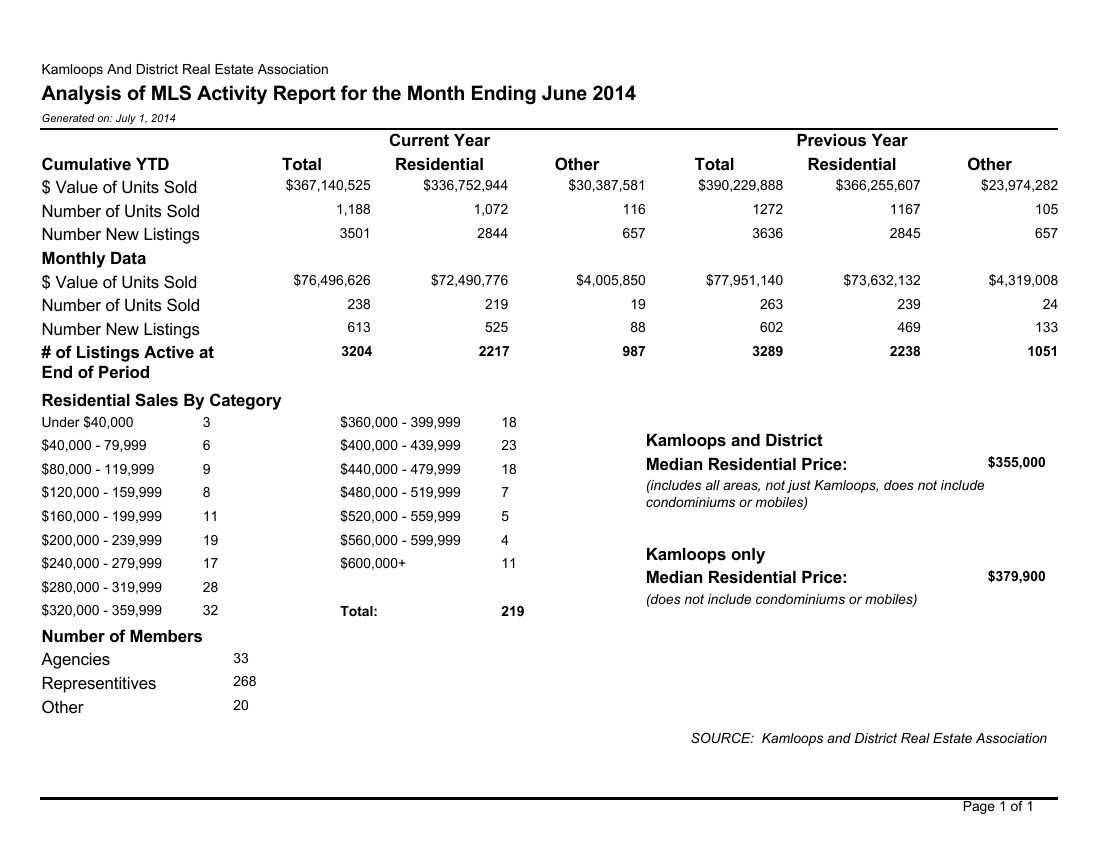
The median price of a house sold in Kamloops last month was $359,500. One year before, it was in the $353,000 range. While prices haven’t seen any dramatic change, the expectations of buyers and sellers have, Peressini said.

Sellers have to price close to what they’ll accept, not buffer their selling figure with several thousand extra for additional negotiation room, he said. “You have to be close to the mark because there is competition out there.”

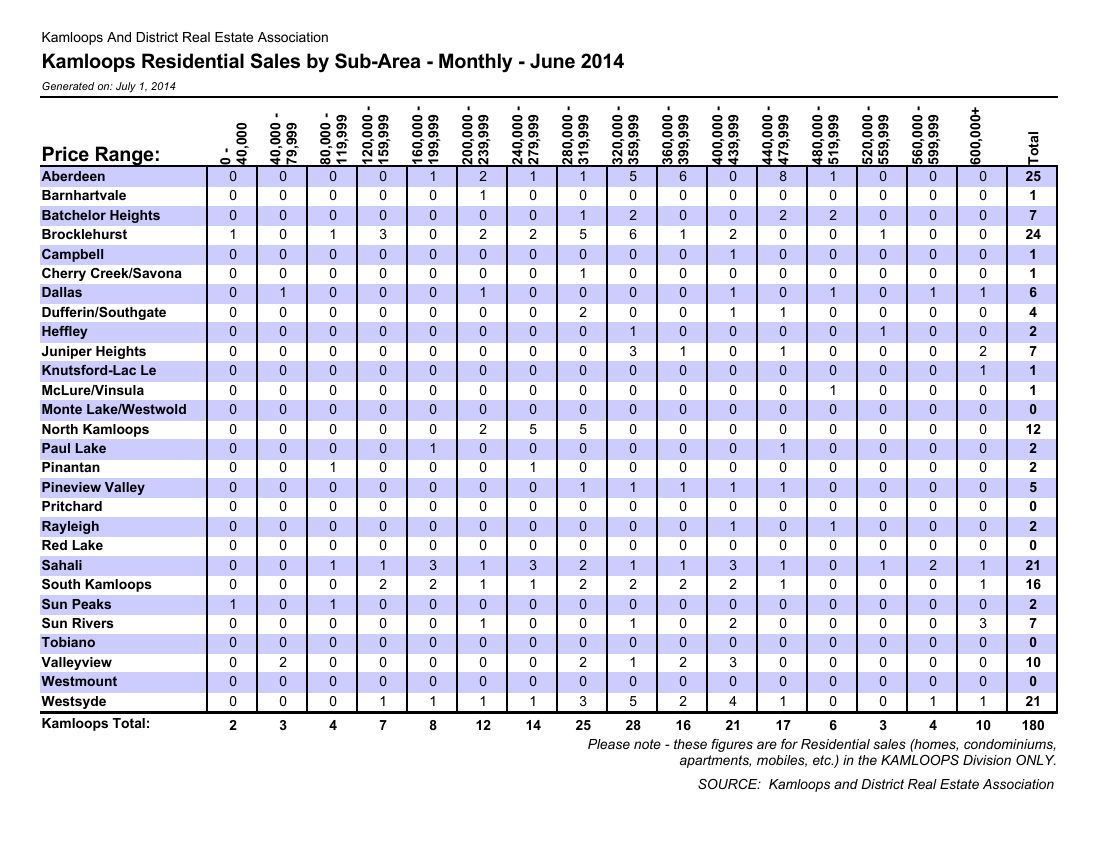
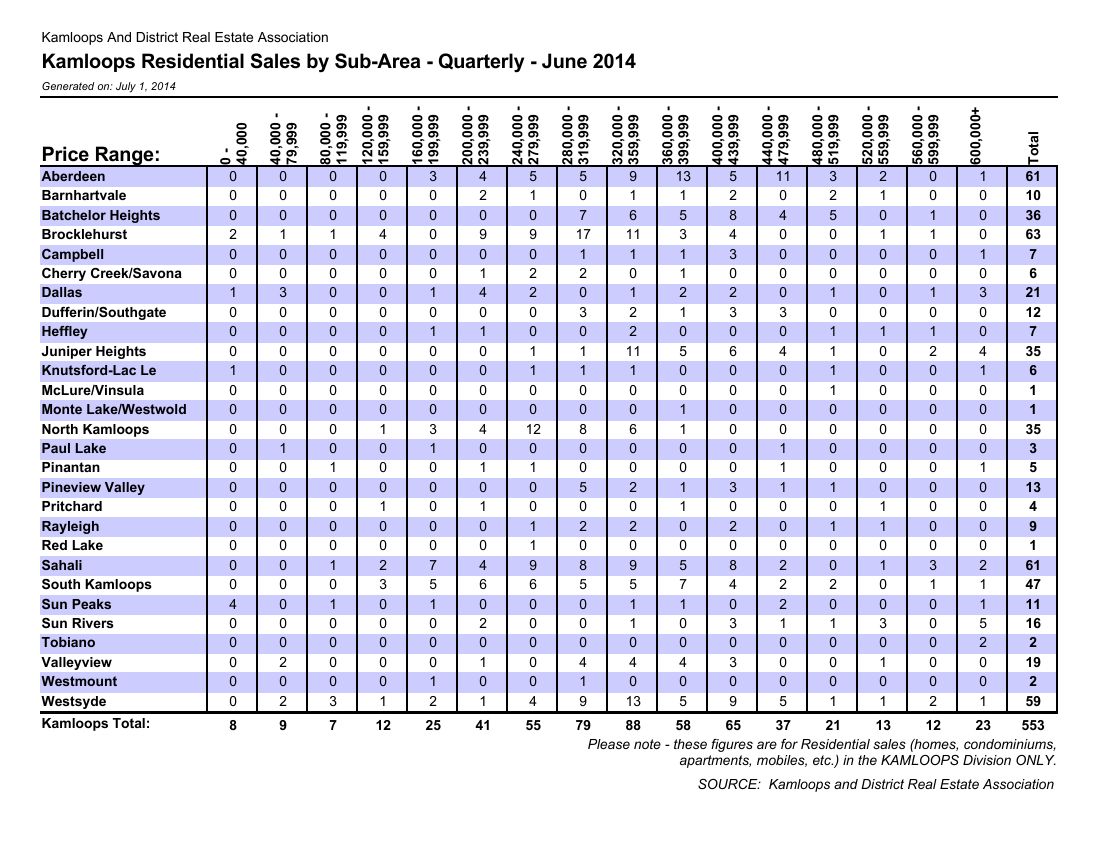
Where you live in Kamloops makes a difference to your property assessment. Here are B.C. Assessment’s changes for 2013:

Going up:

* Sahali, 0.56 per cent
* South Sahali, 0.19 per cent
* Westmount and Bachelor Heights, 0.38 per cent
* Juniper Heights, 0.32 per cent
* Barnhartvale, 6.153 per cent

Going down:

* North Shore, 0.20 per cent
* Valleyview, 0.60 per cent
* Aberdeen, Dufferin, 0.51 per cent
* Westsde 0.33 per cent

Average property value changes by community for residential and business:

* Kamloops, 0.93 per cent, 3.92 per cent
* Barriere, 1.67 per cent, 3.99 per cent
* Clearwater, 4.73 per cent, 1.79 per cent
* Merritt, -0.26 per cent, 3.16 per cent

* Ashcroft, 0.23 per cent, -0.14 per cent
* Cache Creek, 0.57 per cent, 3.84 per cent
* Chase, -2.11 per cent, 2.45 per cent
* Clinton, 1.77 per cent, 0.55 per cent
* Logan Lake, 2.12 per cent, 5.21 per cent
* Lillooet, -2.22 per cent, 9.11 per cent
* Lytton, -0.13 per cent, 1.07 per cent
* Sun Peaks, -0.60 per cent, 0.43 per cent

Building Boom in Kamloops, Kamloops This Week

This article appeared in the Kamloops This Week on January 3rd, 2013 and was written by Andrea Klassen.

New Construction Kamloops BC Real EstateFor the first time since 2008, Kamloops has handed out more than $200 million in building permits in a single year.

The city’s latest statistics show $202-million in permits were given out in 2012, compared to $162.5 million in 2011.

City staff had originally predicted they would hand out between $130 and $150 million in permits this year, but a number of major projects drove the estimate up.

Among those was the Telus data centre. Its $30-million permit accounted for nearly all the $31-million in commercial-building permits issued in December 2012.

“That’s the one that put us over,” said city director of development and engineering services Marvin Kwiatkowski, who expects the big-ticket projects to continue into 2013.

“There’s still some others coming through the door, so I think we’re going to have a good start this year as well.”

Among the projects on the horizon are an $8-million permit for interior work on the new law building (the revamped Old Main Building) at Thompson Rivers University, a new $2.2-million John Deere dealership and a $60-million permit for the new clinical-care and parkade building at Royal Inland Hospital.

“It’s positive, because it’s putting people to work,” Kwiatkowski said. “When you’re having large projects of that nature, you’re having a lot of activity in the city. So, that’s a positive for our economy.”

After two years of relatively flat residential-construction numbers — 350 units of new housing were built in 2012, compared to 400 in 2011 — Kwiatkowski said that sector will probably pick up this year.

“We’ve got three larger multi-family projects, totalling just over 200 units. It could be close to $20 million with these three projects alone,” he said. That is more multi-family units than were built in the city in all of 2012.

For 2013, Kwiatkowski is predicting the city will hand out about $160-million in permits. Taking into account the projects he’s already aware of, Kwiatkowski is confident that target will be met.

“If you throw in all these projects here, including the hospital, we’re close to $100 million. And, if I put in residential like we’ve had the last couple of years, that’s another $40 million,” he said.

From there, smaller projects should fill the $20 million gap.

Kwiatkowski is also hoping to see more single-family home permits handed out in 2013 — a trend that often follows a period of heavy commercial construction.

Only 131 permits for single family homes were given out in 2012, two fewer than in 2011.

City on Pace to Challenge Construction-value Record

This article appeared in the Kamloops This Week on December 4th, 2012 and was written by Andrea Klassen.

The clock is ticking down, but director of development services Marvin Kwiatkowski is confident the city’s building-permit numbers for 2012 are going to break the $200-million barrier before the end of December.

With the release of November’s statistics, the city is standing at $167 million in permitted construction, up from last year’s overall total of $157.6 million.

One major project the city has been expecting all year — the $30-million Telus data centre — will apparently finally go through before the calendar rolls over.

“I’d put money on it,” Kwiatkowski said when asked if the city would end the year above the $200-million mark.

It would be only the second time Kamloops has doled out permits at that level.

In 2008, the record year to date, the city ended the year with $207-million in permits.

Overall, the city gave out permits worth more than $10 million for the month of November, compared to more than $11 million in November 2011.

Of that, residential projects totalled $6.6 million, down from $8.4 million in November 2011, while commercial endeavours were worth $3.2 million

November saw the city issue 15 single-family home permits, a higher than average number for 2012.

Kwiatkowski said the sudden rise comes as a new B.C. Building Code is about to go into effect on Dec. 20.

“Whenever you have a change of code, people want to get in the door,” he said.

Those who snap up permits before the 20th have two years to build under the old code, without having to worry about changes found in the new document.

While the city is set to exceed both its initial and revised construction-value estimates for the year, it’s still slightly below projections on residential units.

So far, 341 units have been permitted this year, compared to 383 at this time in 2011.

Development and engineering services had estimated there would be 350 units.

1 159 160 161 162 163 224