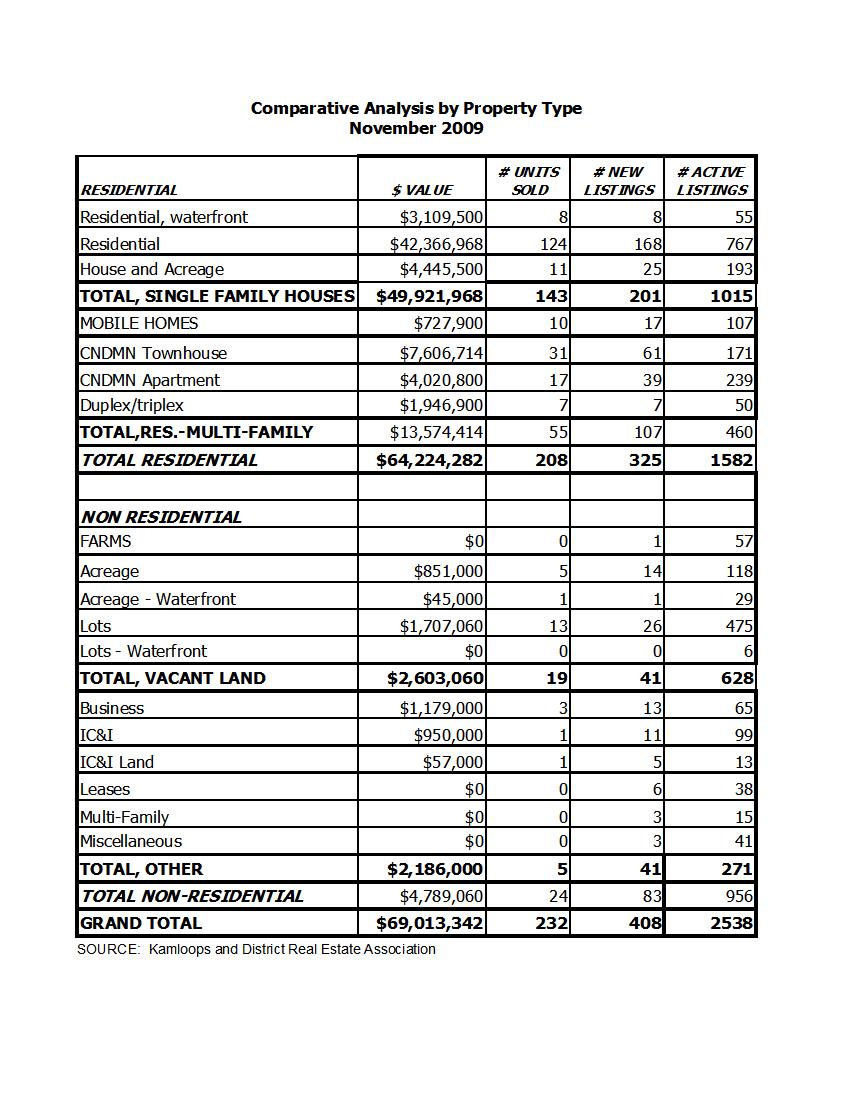
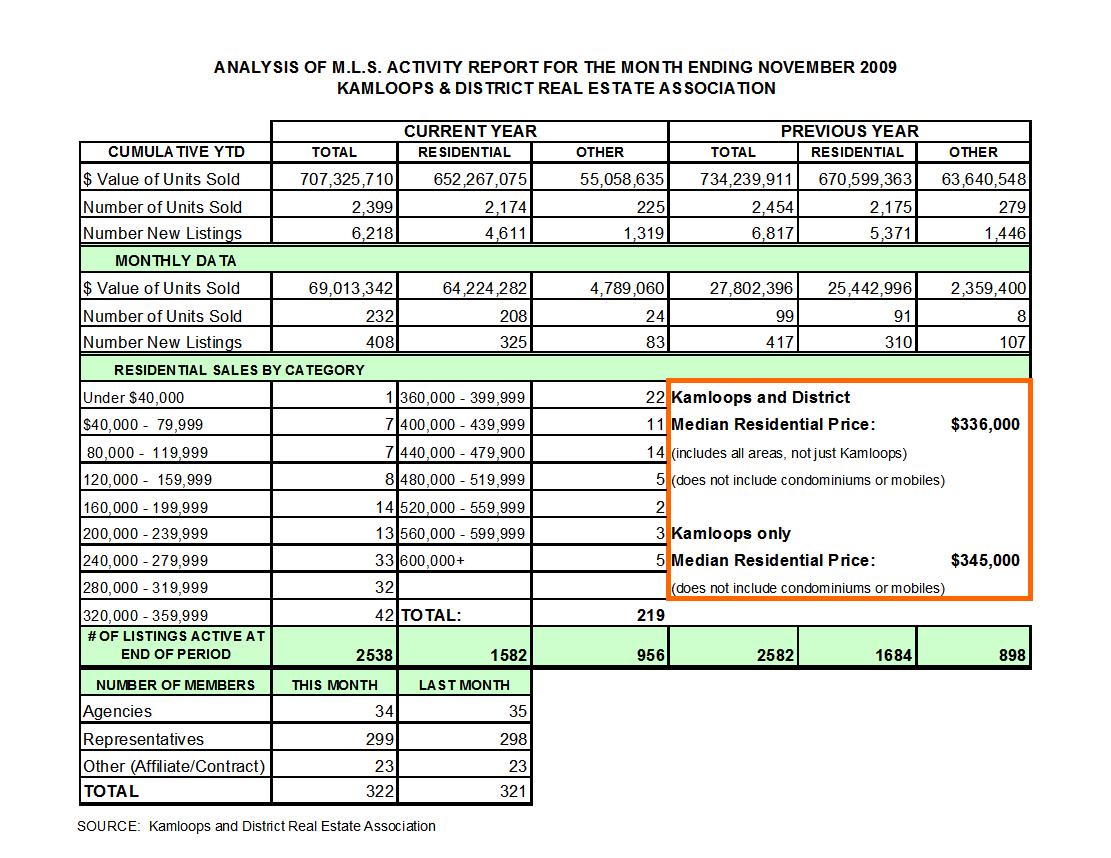
The Kamloops and District Real Estate Association released their latest statistics for the Kamloops real estate market for November 2009. Residential sales are up significantly over the same month last year. Click on the images below to enlarge.
Kamloops Real Estate Comparative Analysis by Property Type November 2009
Kamloops Real Estate Sales by Subarea November 2009
The B.C. Real Estate Association recently released their 2009 Fall Housing Forecast. I have included the info specific to Kamloops below. You can also view the full PDF at the bottom of the page.
The Kamloops housing market is exhibiting balanced conditions and stable home prices, with buyers and sellers on equal footing. MLS® residential sales in Kamloops are estimated to decline 2 per cent this year to 2,200 units. However, an increasingly diversified local economy has lessened the impact of the recession and will contribute to a double digit rebound in home sales next year.
While an increase in home sales to end users has been evident of the past several months, recreation buyers have yet to come back into the market in significant force. Recreation buyers typically lag improved market conditions and are expected to increase their buying activity in 2010. MLS® residential sales are forecast to rise 18 per cent to 2,600 units in 2010. From a historical perspective, homes sales in 2010 will post a similar level to that recorded in the 2003-2004 period. Despite the financial crisis and a global recession, the average MLS® residential price in Kamloops is estimated to be down 2 per cent on an annual basis from a record $307,369 in 2008.
In contrast to the last 18 months, home prices in Kamloops are expected to be relatively stable in 2010, albeit forecast to climb 2 per cent to $308,000 as an annual average. Larger price appreciation in 2010 is less likely as improvement in the economy will be offset by expected increases in mortgage interest rates during the latter half of the year.
After declining 24 per cent in 2008, housing starts in the Kamloops CA are estimated to fall an additional 28 per cent to 415 units this year. A slowdown in the expansion of the housing stock helps support home prices in both the new and resale housing markets. However, lower inventory levels and stronger consumer demand is expected to induce increased new construction activity in 2010. A total of 545 housing starts are forecast for the Kamloops CA next year, with the largest increase occurring in single detached construction.
Purchasing a home in Kamloops is one of the biggest purchase most of us will ever make, and a mortgage can also be a powerful financial tool. No surprise then that a growing number of Canadians have started to ask some smart questions about their mortgage when considering purchasing real estate. In fact, more than 40% of all Canadian mortgages are now arranged through mortgage brokers. Why? Read on;
Choice. A broker has access to mortgages from a huge range of lenders – so their clients have by far the best choice of rates and mortgage options. With partners in a vast network of over 30 lending institutions, including banks, credit unions, trusts, national and regional lenders, and non-traditional lenders, your broker can help design the perfect mortgage for you.
Independence and objectivity. A mortgage broker actually works for you, not for any one lender. That kind of objectivity means that you – the client – are the focus. They fit the mortgage to the client, not the other way around. You’ll get the best rate for your situation.
Promotions. You may not realize it, but there are sales and promotions in the mortgage world, too. Lenders often offer special rate promotions, for example. Your broker will know about these special offers, and whether they might work in your situation.
Expertise. With 35-year amortizations, re-advanceable mortgages (mortgage combined with a line of credit), no income documentation products for the self employed, credit repair and debt consolidation solutions, today there are mortgages for almost any situation. And your independent mortgage broker knows them all. That’s what you want: someone who’s focused on the mortgage marketplace and your needs.
Rates. Getting a lower rate can potentially save you thousands of dollars. That’s why more homeowners are more likely to call a mortgage broker to check out their options for their first mortgage and at renewal. Call early; your mortgage broker can usually guarantee an interest rate for 90-120 days.
One credit inquiry. Rate-shopping on your own can actually be hazardous to your credit. Every time a lender checks your credit, the credit bureaus take notice. Too many inquiries and your credit rating can weaken, possibly affecting the rate and terms of your mortgage. Your broker does one inquiry only, regardless how many lenders you’re looking at.
No cost to you (o.a.c). As a rule, the winning lender pays compensation to your broker for the services and solution provided.
Personal attention. You need a mortgage plan that is a custom fit for you, and a broker who keeps in touch with you during your mortgage years. Keep in mind that their business is built primarily through referrals from satisfied customers, so your positive mortgage experience is essential for their ongoing business growth.
Your mortgage is a big decision and a powerful financial tool. For your next mortgage contact me anytime. I am a local Kamloops mortgage broker who is trained and ready to help you achieve your financial and home ownership goals.
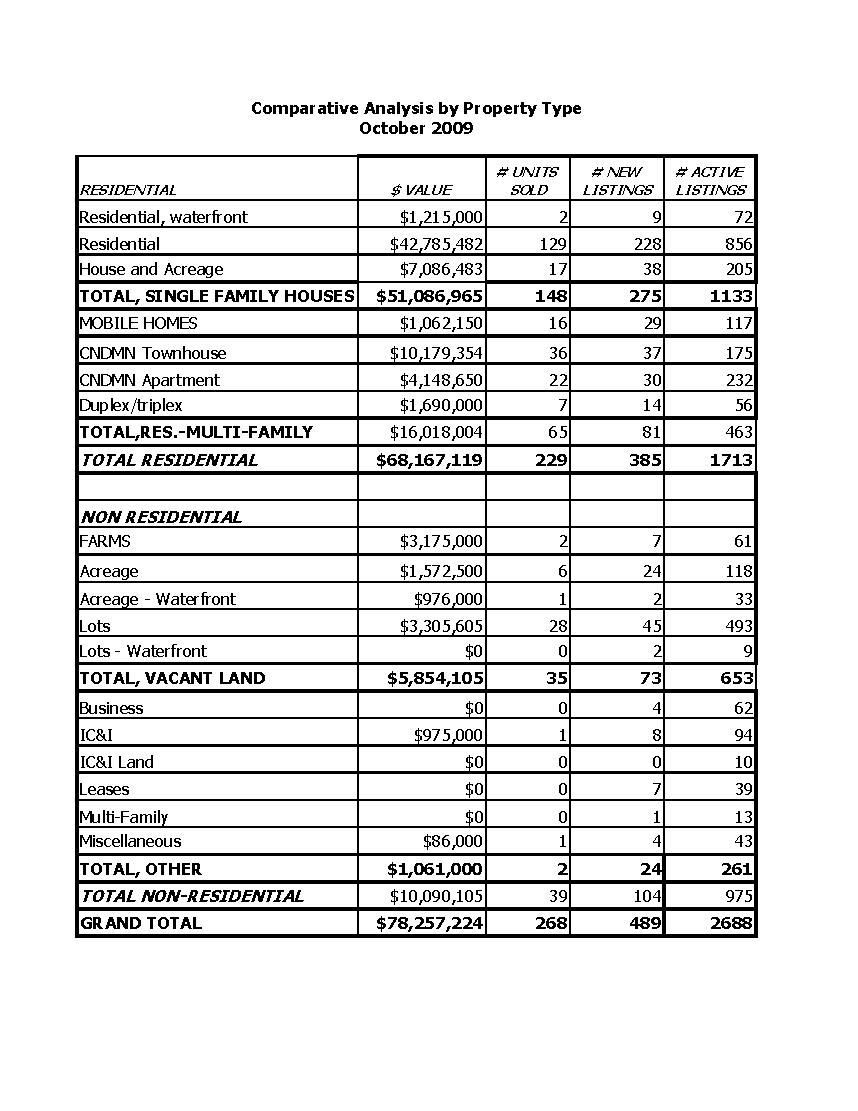
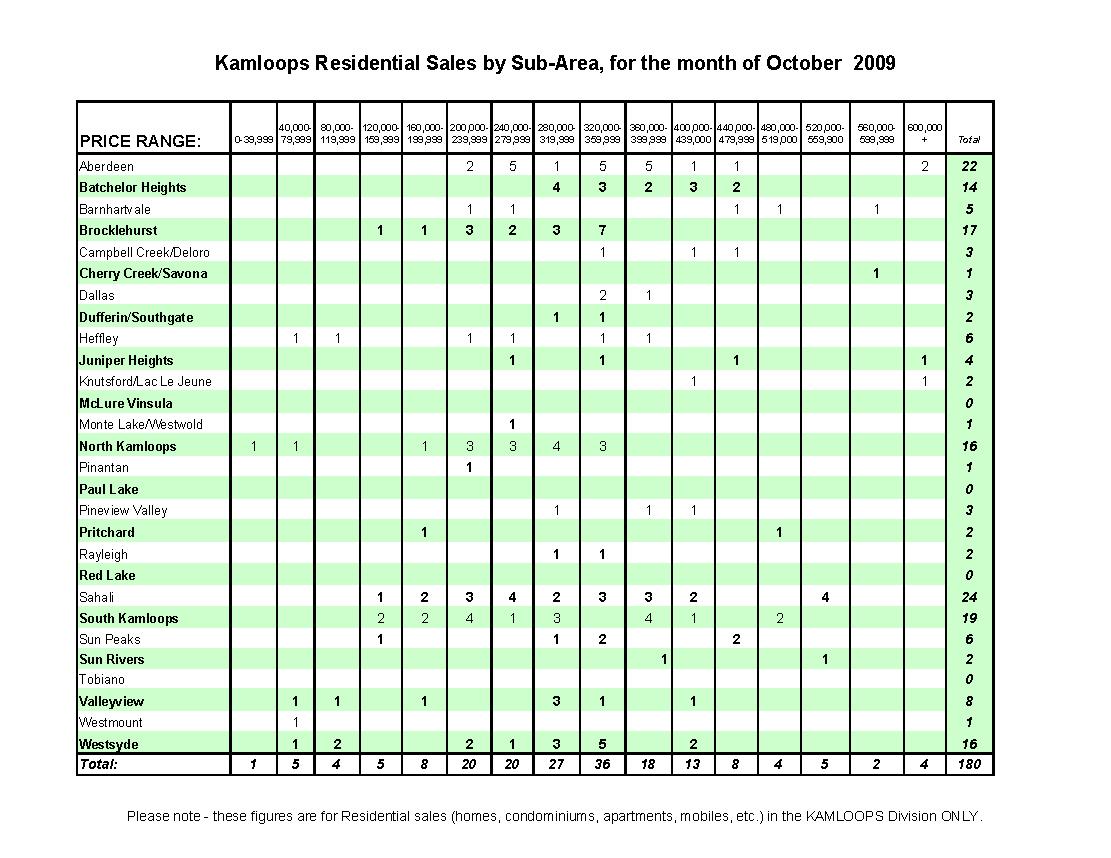
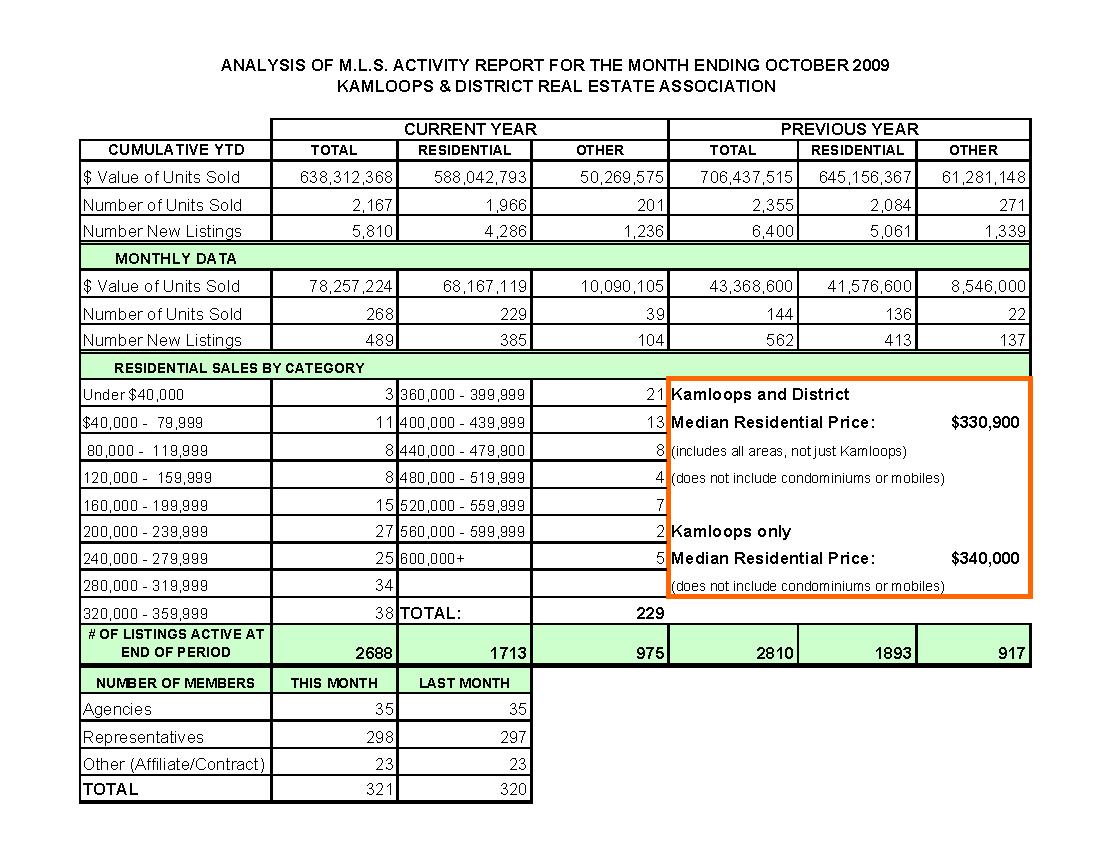
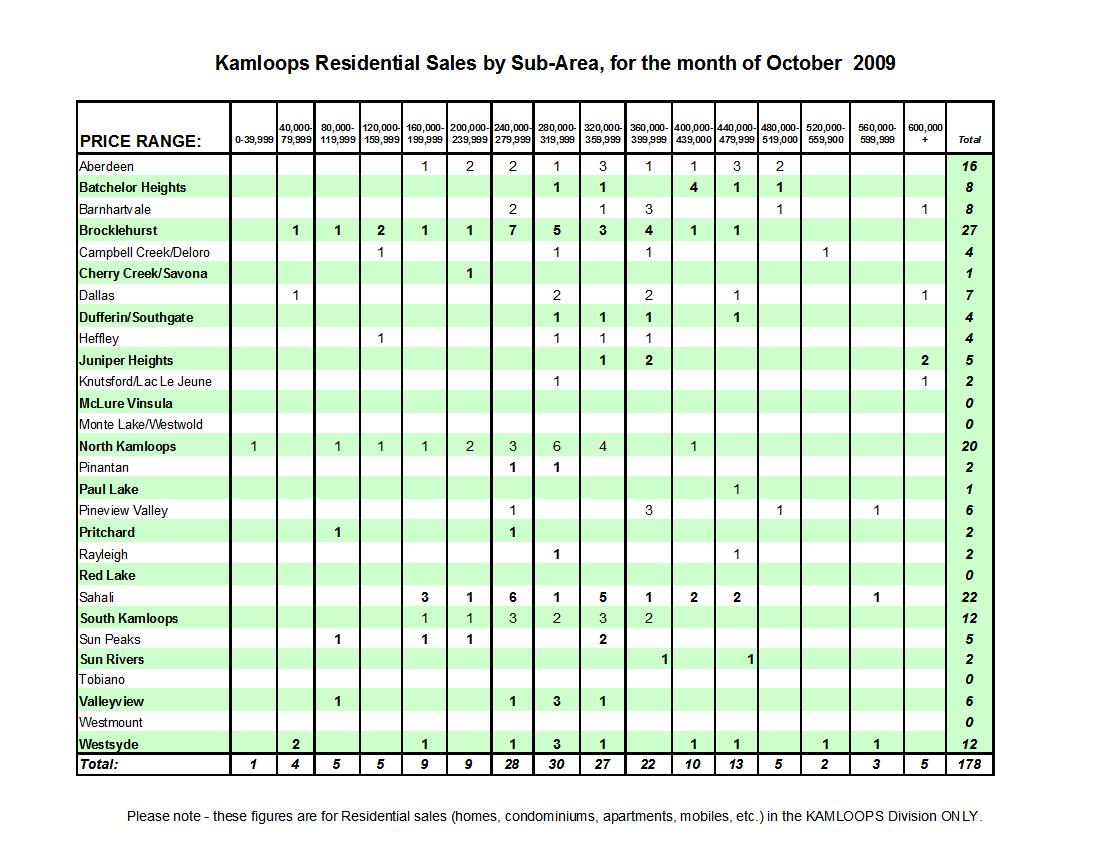
The Kamloops and District Real Estate Association (KADREA), released their latest statistics today. The residential sales for October 2009 were up significantly over October 2008. Click on the images below to enlarge.
Kamloops Real Estate Comparative Analysis by Property Type October 2009
Kamloops Real Estate Sales by Subarea October 2009

 Purchasing a home in Kamloops is one of the biggest purchase most of us will ever make, and a mortgage can also be a powerful financial tool. No surprise then that a growing number of Canadians have started to ask some smart questions about their mortgage when considering purchasing real estate. In fact, more than 40% of all Canadian mortgages are now arranged through mortgage brokers. Why? Read on;