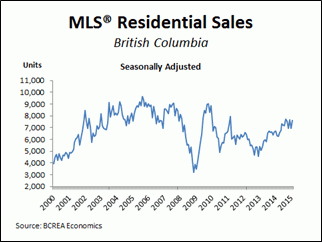
Vancouver, BC – March 13, 2015. The British Columbia Real Estate Association (BCREA) reports that a total of 6,661 residential unit sales were recorded by the Multiple Listing Service® (MLS®) in February, up 19.4 per cent from the same month last year. Total sales dollar volume was $4.3 billion, an increase of 24.8 per cent compared to a year ago. The average MLS® residential price in the province rose to $639,405, up 4.5 per cent from the same month last year.
Click to Enlarge
“Consumer demand remained robust in February on the strength of rock bottom interest rates and improving economic conditions,” said Cameron Muir, BCREA Chief Economist. “After several years of below-average activity, home sales are now trending above long-term levels.”
Total active listings on the market were down 7.5 per cent from a year ago. Fewer homes for sale, combined with elevated consumer demand has the housing market firmly in balanced conditions.
Year-to-date, BC residential sales dollar volume was up 18 per cent to $6.9 billion, compared to the same period last year. Residential unit sales were up 12.4 per cent to 11,038 units, while the average MLS® residential price was up 5.0 per cent at $621,065.
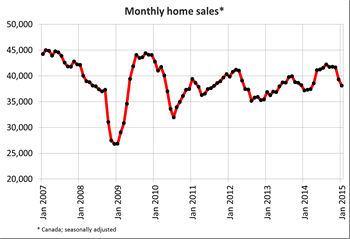
Ottawa, ON, February 17, 2015 – According to statistics released today by The Canadian Real Estate Association (CREA), national home sales activity was down on a month-over-month basis in January 2015.
Highlights:
– National home sales fell 3.1% from December to January.
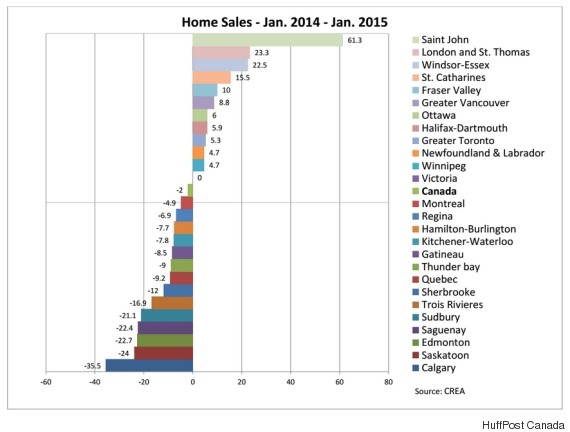
– Actual (not seasonally adjusted) activity stood 2.0% below January 2014 levels.
– The number of newly listed homes rose 0.7% from December to January.
– The Canadian housing market remains balanced.
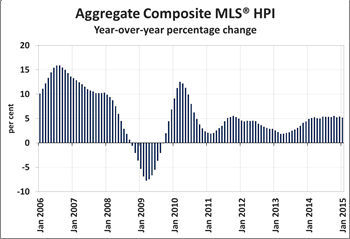
– The MLS® Home Price Index (HPI) rose 5.17% year-over-year in January.
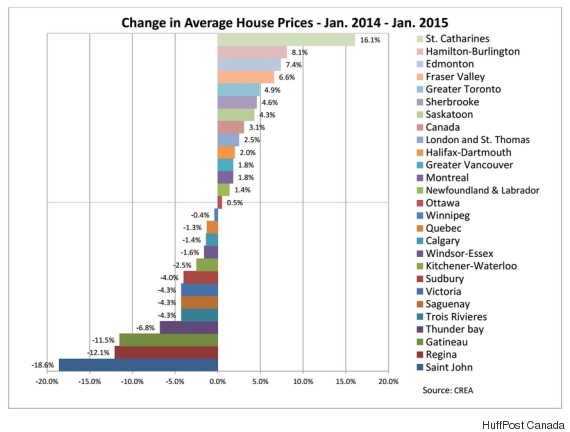
– The national average sale price rose 3.1% on a year-over-year basis in January.
The number of home sales processed through the MLS® Systems of Canadian real estate Boards and Associations fell 3.1 per cent in January 2015 compared to December 2014.
January sales were down from the previous month in about 60 per cent of all local housing markets. On a provincial basis, the monthly decline largely reflected fewer sales in Alberta and Saskatchewan.
Click to enlarge
“As expected, consumer confidence in the Prairies has declined and moved a number of potential homebuyers to the sidelines as a result,” said CREA President Beth Crosbie. “By contrast, housing market trends in the Maritimes are continuing to improve, which underscores the fact that all real estate is local. Nobody knows this better than your local REALTOR®, who remains your best source for information about the housing market where you currently live or might like to in the future.”
Actual (not seasonally adjusted) activity in January stood two per cent below levels reported in the same month last year, marking the first year-over-year decline since April 2014.
“Comparing sales activity for January this year to sales one year earlier, there was a fairly even split between the number of markets where sales were up versus the number of markets where sales were down,” said Gregory Klump, CREA’s Chief Economist. “The decline in national sales largely reflects weakened activity in Calgary and Edmonton. If these two markets are removed from national totals, combined sales activity remained 1.9 per cent above year-ago levels.”
The number of newly listed homes rose 0.7 per cent in January compared to December. New supply climbed higher in just over half of all local markets, led by Edmonton and Greater Toronto. By contrast, Greater Vancouver, Calgary, and Regina posted the largest monthly declines in new listings.
The national sales-to-new listings ratio was 49.7 per cent in January, marking the first time this measure of market balance has dipped below 50 per cent since December 2012.
Click to enlarge
A sales-to-new listings ratio between 40 and 60 per cent is generally consistent with balanced housing market conditions, with readings above and below this range indicating sellers’ and buyers’ markets, respectively. The ratio was within this range in more than half of all local markets in January.
The number of months of inventory is another important measure of the balance between housing supply and demand. It represents the number of months it would take to completely liquidate current inventories at the current rate of sales activity.
There were 6.5 months of inventory nationally at the end of January 2015, its highest reading since April 2013. As with the sales-to-new listings ratio, the reading for the number of months of inventory still indicates that the national market remains balanced.
The Aggregate Composite MLS® HPI rose by 5.17 per cent on a year-over-year basis in January. This continues the trend, in place throughout 2014, where year-over-year price gains held steady between five and five-and-a-half per cent.
Year-over-year price growth held steady in January for one-storey single family homes and decelerated for other Aggregate Benchmark housing types tracked by the index.
Two-storey single family homes continued to post the biggest year-over-year price gains (+6.57 per cent), followed closely by townhouse/row units (+5.00 per cent) and one-storey single family homes (+4.61 per cent). Price growth remained comparatively more modest for apartment units (+3.11 per cent).
Price gains varied among housing markets tracked by the index. As in recent months, Calgary (+7.76 per cent), Greater Toronto (+7.47 per cent), and Greater Vancouver (+5.53 per cent) continued to post the biggest year-over-year increases.
That said, while prices in Greater Vancouver and Greater Toronto continue to trend higher, the trend for prices in Calgary has been fairly stable since last summer while year-over-year gains continue to shrink.
In other markets from West to East, prices were up on a year-over-year basis in the Fraser Valley, Victoria, and Vancouver Island, while remaining stable in Saskatoon, Ottawa, and Greater Montreal. By contrast, prices declined on a year-over-year basis in Regina and Greater Moncton.
The MLS® Home Price Index (MLS® HPI) provides a better gauge of price trends than is possible using averages because it is not affected by changes in the mix of sales activity the way that average price is.
The actual (not seasonally adjusted) national average price for homes sold in January 2015 was $401,143. This represents an increase of 3.1 per cent year-over-year and the smallest increase since April 2013.
The national average home price remains skewed by sales activity in Greater Vancouver and Greater Toronto, which are among Canada’s most active and expensive housing markets. Excluding these two markets from the calculation, the average price is a relatively more modest $312,280, which represents a year-over-year decline of three tenths of one per cent.
These two charts came from the Hufington Post on February 17th, 2015.